
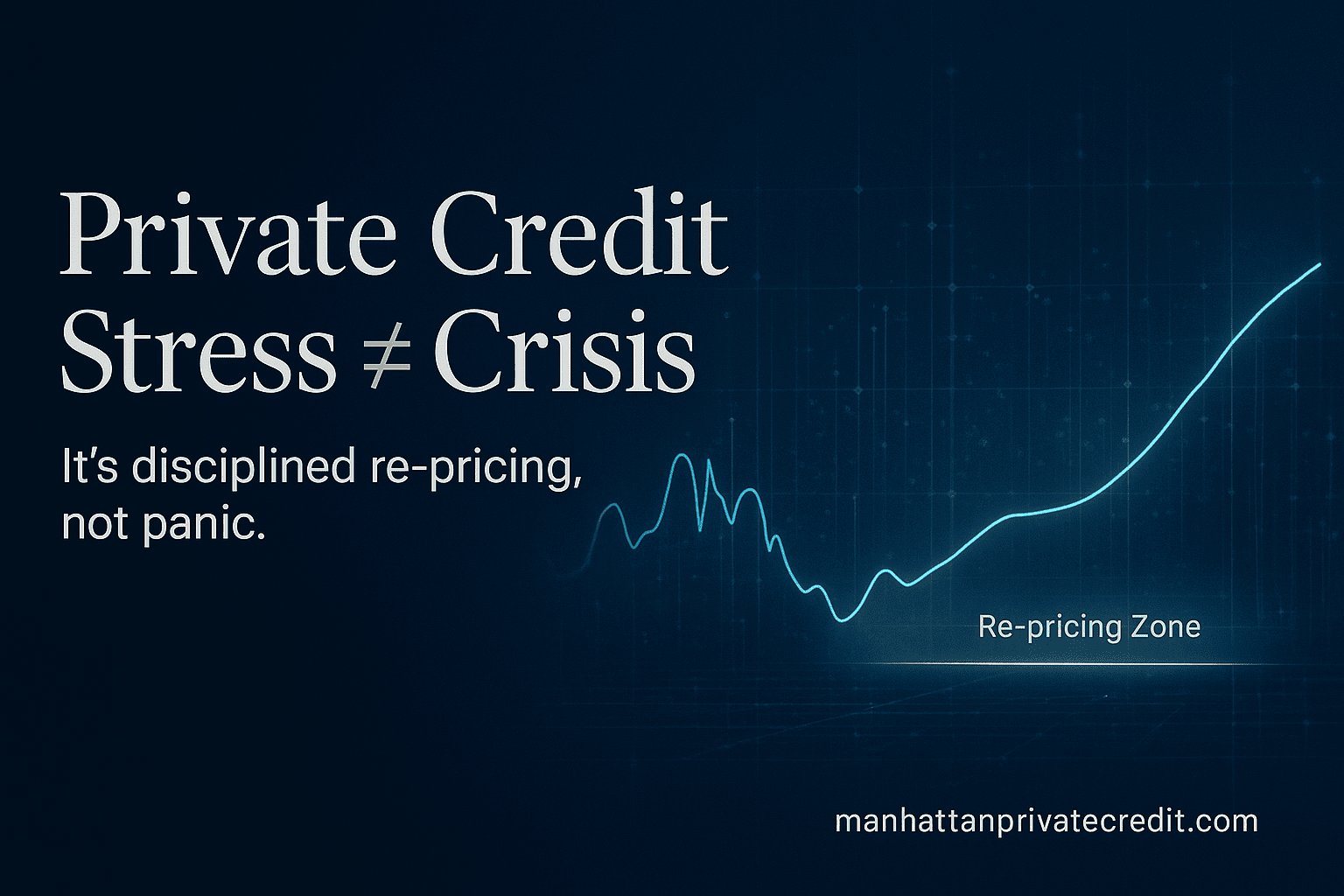
Private Credit Direct Lending Opportunities in Market Stress
Headlines say the $1.8 trillion private credit market is under stress. The Bank of England is warning on risk. Defaults in parts of software are creeping up. Underwriting standards at some of the largest platforms are under scrutiny.
For allocators, the instinctive read is: step back.
That’s a mistake.
For disciplined, relationship-driven lenders, private credit direct lending can turn market stress into a repricing opportunity. Stress is not evenly distributed, and that asymmetry is precisely where opportunity lives.
Why the Private Credit Market Looks "Stressed" Right Now
The current narrative around private credit is simple and loud: too much capital, too fast, now colliding with higher rates and macro shocks.
A more useful view is narrower and more specific.
What the Bank of England Actually Flagged
When the Bank of England highlighted risks in private credit, it was not breaking news for anyone active in direct lending. The market has been digesting several overlapping pressures:
- Rate regime change: Higher base rates have raised the cost of capital for leveraged borrowers.
- Geopolitical risk: Conflicts, including developments in the Middle East such as Iran-linked tensions, add volatility and uncertainty to funding and trade.
- Sector-specific weakness: Parts of the software and technology ecosystem, especially where valuations and leverage were stretched, are now seeing higher default and amendment activity.
- Earlier underwriting choices: Some large platforms loosened standards and pushed structures harder during the last phase of the cycle to support AUM growth.
The Bank’s concern is rational: leverage plus opacity plus rapid growth always deserves scrutiny. But that is not the same as saying the entire asset class is structurally unsound.
Where the Stress Is Showing Up: Sectors and Structures
Current stress is not uniform across private credit. It is more visible in specific combinations of:
- Aggressive leverage on cyclical or unproven cash flows
- Covenant-light or covenant-absent structures that delayed hard conversations
- Sponsor dynamics where the capital stack was engineered for growth assumptions that no longer hold
- Scale-focused platforms that prioritized deployment velocity over borrower selectivity
In other words, stress is more about past behavior than about the mere existence of private credit.
Why Headlines Overstate "Systemic" Private Credit Risk
Private credit is still, by design, idiosyncratic. Deals are bespoke. Structures vary. Lenders and borrowers are not homogeneous.
When a single platform or sector makes headlines, three things tend to happen:
- The media generalizes from a visible problem to an entire asset class.
- Public market investors extrapolate systemic risk based on limited data.
- Allocators feel pressure to treat private credit as one monolithic exposure.
The reality on the ground is different: stress is cluster-based, not system-wide. That distinction is critical for anyone deciding whether to exit, hold, or increase exposure.
Stress vs. Repricing in Private Credit Direct Lending
The key question is not, "Is the private credit market under stress?" It is, "What is being repriced, by whom, and in whose favor?"
Stress in the Mass Market Is Not Stress in Every Structure
Mass-market stress shows up in headlines, indices, and aggregated data. Structural stress shows up inside specific capital stacks and portfolios.
A few practical distinctions:
- Fund-level stress can be driven by redemptions, fundraising pressure, or internal return targets.
- Asset-level stress depends on the borrower’s cash flows, balance sheet, and operating reality.
- Structural stress depends on documentation quality—covenants, security, and lender protections.
When large, diversified platforms face fund-level pressure, they may:
- Spend more time on investor relations than on new deal origination
- Become less flexible on existing exposures to preserve optics
- Move slower on new opportunities as committees re-evaluate risk frameworks
None of that automatically applies to smaller, focused direct lenders with cleaner books and fewer legacy issues.
From Fear to Terms: How Repricing Creates Better Entry Points
Stress, for disciplined capital, translates into one main lever: terms.
Repricing can mean:
- Higher spreads on comparable or better credit profiles
- Stronger covenants and security packages as borrowers and sponsors accept tighter terms
- More conservative structures, including lower leverage and improved amortization profiles
- Access to borrowers that previously had their pick of looser capital
For allocators entering or rotating within private credit now, the question is not "Is there risk?"—it is "Am I being paid appropriately for this risk today versus two years ago?"
In many well-structured private credit direct lending opportunities, the answer has improved.
Who Loses in this Phase—and Who Quietly Wins
Those most exposed in this phase of private credit market stress include:
- Platforms that priced for the previous rate regime and did not adjust fast enough
- Managers that optimised for AUM growth, not risk-adjusted returns
- Lenders that sacrificed downside protections to win deals in competitive auctions
By contrast, those positioned to benefit are lenders that:
- Maintained conservative underwriting even when it was unpopular
- Built deep relationships with borrowers and sponsors
- Can now deploy into a market where capital is more selective and terms are better
That is the quiet transfer of returns that often happens after an exuberant phase: from the largest, most aggressive platforms back to more disciplined lenders.
The Real Risk: Allocating to Managers Priced for the Last Cycle
The largest driver of risk in private credit today isn’t the concept of private credit direct lending. It’s misalignment between current conditions and past underwriting.
Underwriting Drift at Scale Platforms
During the boom, some large platforms drifted from their original underwriting standards to sustain deployment:
- Accepting weaker covenants
- Stretching leverage assumptions
- Underwriting optimistic growth scenarios
- Diversifying into less familiar sectors to put capital to work
Those decisions matter more today than any single macro headline. Allocators who ignore underwriting drift are effectively buying the last cycle’s risk at this cycle’s spreads.
Redemptions, Legacy Books, and Distraction Risk
Large platforms carry additional challenges in a stress phase:
- Redemption management can dominate leadership attention.
- Legacy portfolios built under looser conditions can absorb resources.
- Cross-fund considerations may influence how aggressively issues are recognized.
When leadership time is consumed by stabilizing the existing franchise, it is not being spent on originating, diligencing, and structuring the best new term sheets.
Why AUM Growth Talk Is a Red Flag in Direct Lending
In a stressed market, if a private credit manager is still framing success primarily in terms of assets under management, that is a tell.
In direct lending, you want to hear about:
- Borrower quality and cash flows
- Loss history and recovery dynamics
- Covenant behavior and amendment discipline
- Sponsor relationships and information rights
If the focus is marketing decks, fundraising targets, and platform expansion, you are not in a credit-first partnership. You are in an asset-gathering machine.
Why Private Credit Direct Lending Is Built for Market Stress
Not all private credit managers approach the market the same way. Relationship-driven direct lenders are structurally better positioned when conditions tighten.
Focusing on Borrower Quality, Not Fund Volume
At Manhattan Private Credit, the starting point has always been the credit quality of the borrower, not the size of the fund.
This distinction matters most when the cycle turns:
- Portfolios tilt toward durable, cash-generative businesses
- Exposure to the most aggressively structured deals is limited
- There is less pressure to defend marginal credits to protect fundraising narratives
When platforms are forced to defend prior decisions, relationship-driven lenders can stay focused on today’s opportunity set.
Information Edge: Real-Time Data from Operating Counterparties
Deep lender–borrower relationships create an information edge in stressed markets:
- Faster visibility into operational performance and leading indicators
- More candid dialogue about challenges and trade-offs
- Greater ability to proactively restructure on sensible terms, rather than react under duress
That information edge is a core asset in event-driven and alternative credit strategies. It is also something that cannot be replicated overnight by scale alone.
Structuring and Covenants When Capital Gets Selective
In a looser market, the marginal dollar often wins on price or leniency.
In a selective market, disciplined capital wins on structure:
- Reinstating or tightening maintenance covenants
- Securing stronger collateral packages and guarantees
- Embedding information and consent rights that protect downside
Relationship-driven lenders can negotiate these protections precisely because they are not chasing every deal. They can say no. That optionality is invaluable when stress is rising.
How Allocators Can Use Private Credit Direct Lending in Market Stress
Private credit market stress can either push you into defensive retreat—or become the moment you upgrade the quality of your exposure.
Questions to Ask Your Private Credit Managers Today
A few practical questions to put to any manager:
- Underwriting discipline
- How did your underwriting standards change between 2020 and 2022?
- What is one type of deal you were doing then that you would not underwrite today?
- Legacy book and problem credits
- Where are you seeing the most pressure in your existing portfolio?
- How much internal time is allocated to workout versus new origination?
- Repricing and new deployment
- How have spreads, structures, and covenants changed in your new deals over the last 12–18 months?
- What are you doing differently with documentation now compared with the prior cycle?
You are testing for clarity, humility about past risk, and specificity about current behavior.
Signals of Discipline vs. Asset Gathering
Signals of a discipline-first lender:
- Willingness to walk away from deals and explain why
- Transparent discussion of realized and expected losses
- Emphasis on borrower selection and counterparty relationships
- Modest marketing around AUM and aggressive marketing around process
Signals of an asset-gathering platform:
- Emphasis on scale, brand, and fund count
- Vague language about risk frameworks and underwriting changes
- Reluctance to discuss problem credits in detail
- Heavy focus on product shelf rather than credit work
Aligning with Managers Built for This Phase of the Cycle
This phase of private credit market stress rewards managers who:
- Entered the cycle with cleaner books and tighter standards
- Have direct, trusted relationships with operating counterparties
- Are actively deploying into repriced risk, not just defending prior vintages
As an allocator, aligning with managers focused on disciplined private credit direct lending can:
- Improve your forward-looking risk/return profile
- Reduce exposure to headline-driven redemption spirals
- Preserve the role of private credit as a steady, contractual cash-flow allocation within a broader portfolio
FAQ: Private Credit Direct Lending in a Stressed Market
Is private credit market stress a reason to pull back from the asset class?
Not by default. Stress is a reason to differentiate, not to generalize. It is a time to reassess managers, terms, and structures—not to abandon the entire opportunity set.
What is the difference between stress and repricing in private credit?
Stress is the pressure you see. Repricing is the shift in economics that follows. Disciplined investors focus on the latter.
Where is private credit stress currently most concentrated?
More in certain sectors, structures, and platforms than in the asset class as a whole—particularly where leverage and lenient documentation intersected with optimistic growth assumptions.
How should I evaluate private credit managers in this environment?
Re-underwrite their track record, underwriting behavior, and current positioning. Ask concrete questions about legacy exposures, problem credits, and how new deals are being structured today.
Why can private credit direct lending have an advantage in stressed markets?
Relationship-driven direct lenders can carry fewer legacy issues, face less pressure to deploy simply for scale, and remain focused on originating and structuring new transactions at repriced spreads and stronger terms.
How can allocators turn current private credit volatility into an opportunity?
By reallocating from managers who priced the last cycle to managers whose process, relationships, underwriting discipline, and direct lending approach are built for this one.
Connecting Capital Through Private Credit Direct Lending
One-off hits do not invalidate private credit. They reveal where risk was mispriced—and where discipline now commands a premium.
When the giants are managing redemptions, someone else is writing the best new term sheets. The core decision for allocators is simple: which side of that trade are you on?
At Manhattan Private Credit, our approach to private credit direct lending remains focused on borrower credit quality, direct relationships, and disciplined structures. That is how we approach Connecting Capital—the right way.
Learn more at manhattanprivatecredit.com. For a deeper dive into current conditions, see our April market briefing.