
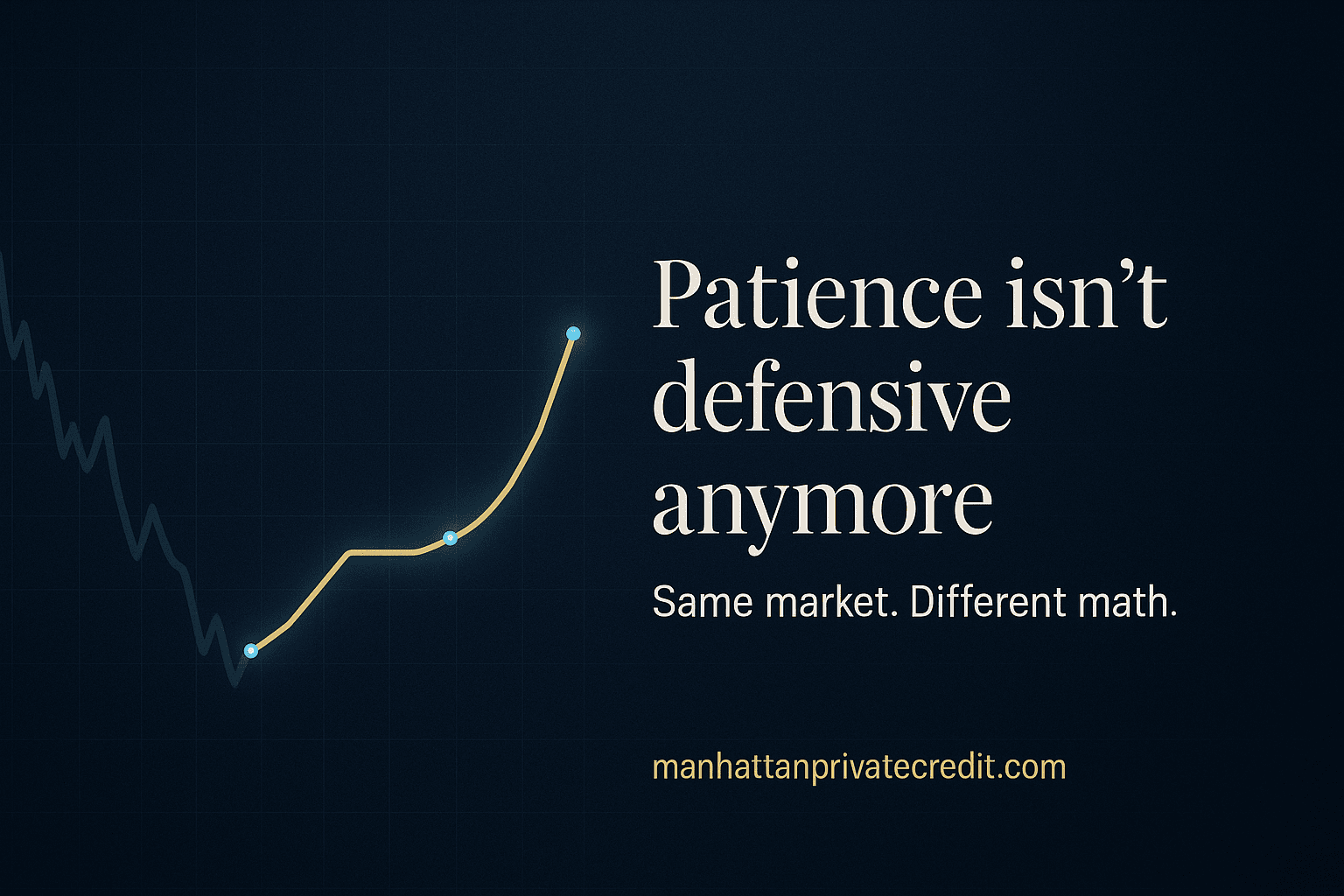
Private Credit Strategies for Structured Downside Protection
Markets used to reward patience. Park your capital in broad equities, wait long enough, and the drawdowns were the price of admission.
That model is breaking.
Capital that calls itself “defensive” but still drops with every index pullback isn’t actually defensive. It’s just exposed more slowly.
This is why institutions quietly shifted from hoping to positioning. Alongside private credit strategies, one of their tools is capital protected structured notes—structures designed to stay cushioned in selloffs while still participating when markets recover.
This piece is a direct look at what those instruments are, how they behave in real drawdowns, and when it actually makes sense for an accredited investor to use them.
Why "Safe" Capital Isn’t Actually Defensive Anymore
The old model: park, wait, hope
For decades, the default playbook was simple:
- Allocate heavily to public equities.
- Add some bonds for ballast.
- Tell yourself that volatility is “noise” and time will fix everything.
On paper, that sounds conservative. In reality, it means you absorb every major drawdown, then hope the recovery timeline matches your life and liquidity needs.
If your “safe” or “conservative” capital is down 15–25% every time the index sells off, you’re not managing risk. You’re outsourcing it to the market and calling that prudence.
How modern markets punish passive exposure
Today’s markets are:
- More mechanical (flows, options, and structured products drive behavior).
- Faster to gap, both up and down.
- Dominated by players explicitly managing around drawdowns, not sitting through them.
When volatility spikes, the market doesn’t care that your plan is “long term.” It just marks your exposure to the new reality—instantly. If you’re fully exposed to that mark-to-market pain, your optionality disappears at the precise moment when capital is most valuable.
What institutions changed years ago
Large institutions—pensions, insurers, sophisticated family offices—did not simply “get more patient.” They changed the tools:
- They designed payoff profiles that accept some cap on upside in exchange for defined downside parameters.
- They shifted part of their exposure from simple beta to structured capital solutions.
- They treat drawdown management as a core objective, not an afterthought.
Capital protected structured notes are one of those tools. They are not a silver bullet, but they are a different game than “own the index and absorb whatever happens.”
What Are Capital Protected Structured Notes?
Plain-English definition and mechanics
In plain terms, capital protected structured notes are investment contracts—typically issued by a bank or institutional counterparty—that combine:
- A debt-like component (which targets the return of principal at maturity, subject to conditions and issuer credit risk), and
- One or more options on an underlying asset (equity index, basket of stocks, rate, etc.).
The result: a payoff that is engineered, not incidental.
For example, a structured note might be designed so that:
- If a given index stays above a certain level, you receive a defined coupon or participation in upside.
- If the index drops, your principal is protected up to a certain buffer or barrier at maturity.
The core idea is simple: use options to reshape how your capital behaves across different market paths, instead of just accepting the raw path of the index.
Capital protection versus principal risk
The term “capital protected” is often misunderstood.
In practice, protection can mean:
- A full return of principal at maturity if certain conditions are met (for example, the underlying asset hasn’t breached a deep barrier), or
- A buffer—say, the first 20–30% of losses on the underlying are absorbed by the structure, with losses beyond that point shared by the investor.
Two important realities:
- Issuer credit risk: If the issuing institution fails, the “protection” is only as strong as its balance sheet.
- Path and timing risk: Many protections are defined at maturity, not at every point along the way.
So while capital protected structured notes are explicitly built around downside management, they are not risk-free. They are a more deliberate way of accepting and shaping risk.
Where capital protected notes fit in private credit strategies
In a sophisticated portfolio, capital protected structured notes often sit between:
- Pure cash or short-term instruments, and
- Fully unhedged equity or growth exposure.
They can be used to:
- Put idle or “nervous” capital to work with defined downside parameters.
- Replace part of a long-only equity sleeve with something more path-aware.
- Complement private credit strategies and other income approaches by reducing the chance that the overall portfolio is dragged down by public market swings.
For accredited investors, the appeal is straightforward: defensive posture without simply staying in cash.
How Capital Protected Structured Notes Aim to Stay Flat in Selloffs
Using buffers, barriers, and cushions
The mechanics differ by issuer and structure, but most protective notes use some combination of:
- Buffers: The structure absorbs a certain percentage of losses on the underlying (e.g., you are protected against the first 20% decline).
- Barriers: Protection applies as long as the underlying doesn’t breach a deep barrier (e.g., a 40–50% drop). If it does, you may participate more directly in losses.
- Coupons or defined payoffs: You may receive fixed or conditional coupons as long as triggers are not breached, providing return even in sideways or mildly negative markets.
The objective is not to eliminate all loss in every regime. It’s to flatten the impact of common drawdowns and reserve real pain for truly extreme scenarios.
Why staying flat in a drawdown is powerful math
Consider two paths over a volatile period:
- Path A (index): Down 20%, then up 25%.
- Path B (structured note): Roughly flat during the 20% drawdown (due to protection), then participates in a portion of the subsequent upside.
Even if Path B doesn’t capture 100% of the rebound, starting from no drawdown makes a profound difference.
When institutional investors say, “Our structured note portfolio stayed flat—and still captured the upside on the recovery,” that’s the underlying logic:
- Protect when others are absorbing pain.
- Stay positioned to participate when the recovery arrives.
Over multiple cycles, avoiding large drawdowns often matters more than squeezing out the last incremental bit of upside in calm markets.
A simple scenario: S&P falls, structured note holds
Imagine the S&P 500 drops meaningfully in a quarter. A traditional equity-heavy portfolio moves down in lockstep.
A capital protected structured note referencing the S&P might be designed so that, over its term:
- The first segment of losses is absorbed by the structure’s buffer.
- You continue to accrue a predefined coupon, as long as deep barriers are not breached.
In that scenario, while the index is printing double-digit red, your structured exposure can be roughly flat on a mark-to-maturity basis, yet still positioned to benefit if the index stabilizes or rebounds.
That isn’t luck. It’s structure.
Asymmetric Upside: Participating in the Recovery Without Eating the Crash
How the payoff profile is engineered
The defining feature of capital protected structured notes is asymmetry:
- You consciously trade away a portion of uncapped upside or accept constraints on how you earn it.
- In return, you gain a cushion or conditional protection on the downside.
This is different from:
- Leveraged products that amplify both gains and losses, or
- Simple derivatives overlays that hedge but also can bleed premium over time.
The mathematics of these notes are built around specific path assumptions and strike levels. For an accredited investor, the takeaway is not the formula—it’s the shape of the distribution: less left-tail participation, more controlled right-tail participation.
Participating in rebounds after staying protected
When markets recover after a drawdown, fully exposed investors are fighting uphill from a lower base.
Capital protected structures aim to start the recovery phase from a less damaged position because:
- The buffer absorbed much of the initial decline.
- The note’s payoff can still track a portion of the rebound or pay defined coupons.
This is how a portfolio can stay flat during the shock and still “capture the upside on the recovery.” Not every penny of upside, but a favorable combination of:
- Smaller (or no) drawdown, and
- Sufficient participation when conditions normalize.
Why institutions favor asymmetric profiles over beta
Institutions are not obsessed with beating the index every single year. They are focused on:
- Meeting long-term liabilities.
- Protecting funded status.
- Preserving the ability to allocate when others are forced sellers.
For them, avoiding deep and repeated drawdowns is rational. Structured capital solutions, including capital protected notes, are one way to operationalize that logic.
For accredited investors, it’s effectively importing some of that institutional discipline into personal capital.
Who Capital Protected Structured Notes Are Actually For
These are not retail trading toys. They make the most sense when used deliberately, by investors who know what problem they’re solving.
Accredited investors sitting on idle or nervous cash
If you:
- Qualify as an accredited investor,
- Hold meaningful cash or short-duration instruments because public markets feel “too hot” or “too fragile,” and
- Still want your capital to work without taking full equity beta,
then capital protected structured notes may offer a middle ground: defined downside parameters with a path to upside participation.
Operators and founders with concentrated risk
Many founders, executives, and operators have:
- Large exposure to a single company or sector.
- A high correlation between their human capital and their financial capital.
For them, adding more raw equity exposure is often the wrong move. A better approach can be:
- Use structured capital solutions to dial in targeted exposure,
- Cushion against broad market shocks, while
- Preserving the ability to benefit from recoveries and specific events.
Family offices and macro-aware allocators
Family offices and macro-aware high-net-worth investors often:
- See regime shifts coming,
- Dislike pure cash drag, but
- Refuse to wear the full volatility of public markets.
For this group, capital protected notes can be used as:
- A regime-aware sleeve that behaves differently in shocks.
- A complement to private credit strategies, real assets, and other alternatives.
The throughline across all of these segments: awareness that the old “park and hope” model is no longer sufficient.
Key Risks and Trade-Offs You Need to Respect
Any structure that looks attractive on a marketing slide deserves scrutiny. Capital protected structured notes are no exception.
Credit risk and issuer dependence
Most structured notes are obligations of a specific issuing institution. That means:
- Your ultimate outcome depends on the issuer’s ability to meet its obligations.
- Capital protection is only as strong as the issuer’s balance sheet.
This is classic credit risk. Institutions assess it explicitly; individual investors should too.
Liquidity, complexity, and documentation
Structured notes are designed instruments, and that comes with trade-offs:
- Liquidity: Secondary markets may exist but can be thin or at discounts, especially in stress.
- Complexity: The payoff can be non-intuitive without careful explanation and modeling.
- Documentation: The real rules live in the term sheet and prospectus, not in a slide.
For accredited investors, the question is not “Is this product simple?” but “Is this complexity compensating me for something I care about—like downside protection and path control?”
Why structure alone doesn’t fix bad positioning
A capital protected structured note is still a tool. Used poorly, it can:
- Concentrate you in a single underlying you don’t actually believe in.
- Create mismatches between your liquidity needs and the note’s term.
- Introduce risks you don’t understand in exchange for optics you do.
The solution is not to avoid structure. It’s to align structure with strategy—which is precisely what institutional investors do.
How Manhattan Private Credit Builds Downside-Aware Strategies
At Manhattan Private Credit, we do not view capital protected structured notes as standalone “products” to be pushed. We view them as components within broader private credit strategies and downside-first portfolio architecture.
Designing for cushions first, upside second
Our bias is simple:
- Start with the drawdown profile we are willing to accept.
- Use structure to build cushions and buffers into that profile.
- Then ask how much upside participation is rational, given the protection we’ve designed.
That is the opposite of the typical retail approach, which starts with upside stories and waves vaguely at risk.
Using structured notes alongside private credit
Capital protected notes can sit alongside private credit and other yield-oriented strategies to:
- Reduce the probability that public market shocks bleed into every part of the portfolio.
- Maintain optionality when forced selling creates event-driven opportunities.
- Keep capital positioned, not parked, through volatile regimes.
When the S&P sold off in a recent quarter, for example, a well-designed structured note portfolio can remain roughly flat on a mark-to-maturity basis—then still participate when risk assets recover. That’s the type of behavior we care about engineering.
What a conversation with us usually covers
When we speak with accredited investors about structured capital solutions and private credit strategies, we focus on:
- Your real downside tolerance and liquidity constraints.
- How much of your current “safe” capital is actually just slow, correlated risk.
- Where capital protected structures and private credit may, or may not, improve that profile.
No structure is a fit for everyone. But in a world where institutions routinely use asymmetric tools, choosing to avoid them entirely is itself a positioning decision.
More on our approach at manhattanprivatecredit.com.
Frequently Asked Questions About Capital Protected Structured Notes
What are capital protected structured notes in simple terms?
Capital protected structured notes are investment contracts, usually issued by a bank or institutional counterparty, that combine a debt-like component with options on an underlying asset. The goal is to provide a defined level of downside protection (often up to a specific loss threshold or at maturity) while still allowing for participation in upside if the underlying asset recovers or performs within a target range.
Can capital protected structured notes lose money?
Yes. “Capital protected” in practice usually refers to cushion or protection under certain conditions, not an absolute guarantee. Your outcome depends on the specific note design, issuer creditworthiness, time horizon, and how the underlying asset behaves. Notes can experience mark-to-market declines, and some structures only provide protection if held to maturity or if the underlying stays within certain barriers.
Why would an accredited investor use structured notes instead of just holding cash and equities?
Because the combination can be more efficient than the extremes. Cash protects but earns little. Equities can compound, but they fully absorb drawdowns. Capital protected structured notes sit in between—aiming to keep you cushioned or flat in stressed markets while still participating, often in a defined way, when markets stabilize or recover. Institutions use them to shape their return profile rather than simply accept market beta.
How can structured notes complement private credit strategies?
Structured notes can provide a different return profile from private credit by managing exposure to public-market drawdowns while preserving defined upside participation. Used together, they can help diversify sources of income, downside protection, and liquidity across a broader portfolio strategy.
Are capital protected structured notes only for institutions?
Traditionally, structured products have been used most heavily by institutions and large private banks. Today, certain capital protected structured notes are available to accredited and qualified investors through specialized managers and platforms. Access, pricing, and quality vary, which is why working with a team experienced in institutional-grade structuring can matter more than the label on the product itself.
How long is the typical time horizon for capital protected structured notes?
Many capital protected structured notes have maturities ranging from 1–5 years, with common terms around 2–3 years. The protection mechanics and payoff profile are generally defined over that life. These are not intraday trading instruments; they are positioning tools for investors willing to think in multi-quarter or multi-year regimes and who want clearer downside parameters during that period.
How do I know if structured capital solutions are a fit for my situation?
You start with the problem, not the product. If you’re an accredited investor with meaningful idle cash, concentrated exposure, or a portfolio that keeps participating fully in every drawdown, it’s worth examining whether more structured approaches could make your risk/reward profile more deliberate. A detailed review of your capital needs, time horizon, and risk tolerance is needed before deciding whether specific structures are appropriate.
Next Step for More Defensive Private Credit Strategies
If your supposedly conservative allocation keeps tracking every drawdown in the S&P, you’re not being conservative—you’re playing the old game with bigger numbers.
Institutions have spent years moving from waiting to positioning. Capital protected structured notes are one of the ways they do it.
Combined thoughtfully with private credit strategies, structured capital solutions can help investors build a more deliberate balance between income, downside protection, and upside participation.
If you’re an accredited investor sitting on idle or exposed capital and haven’t examined structured capital solutions yet, this is the moment to pressure-test your setup.
Learn more and start that conversation at manhattanprivatecredit.com.