
Private Credit Strategies for Geopolitical Event Risk
Markets are holding their breath. Iran and the US are hours away from another ceasefire deadline. Headlines are loud, but positioning tells a quieter story: geopolitical event risk today is less about catastrophic downside and more about being underexposed if a ceasefire triggers a violent relief rally.
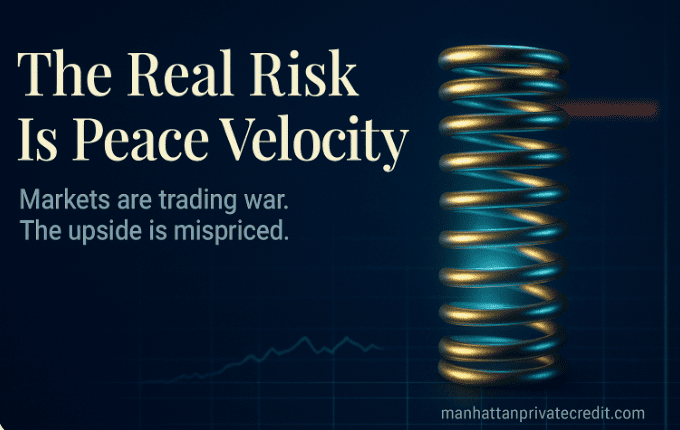
One analyst described US equities as a “coiled spring” with roughly 10% upside on a successful ceasefire. Asian equities are modestly higher. Oil is little changed. The dollar is ticking lower. That’s not panic. That’s cautious optimism from investors who have seen this movie before.
The risk is that they’ve seen it so many times they’ve stopped respecting the opportunity.
For investors considering private credit strategies, these public-market dislocations can also reshape funding conditions, pricing, liquidity, and the opportunity set across the capital structure.
How Geopolitical Event Risk Actually Prices in Public Markets
From shock to fatigue: the lifecycle of geopolitical headlines
Geopolitical event risk rarely hits markets as a single clean shock. It comes in waves:
- Initial shock
The first sanctions, the first strike, the first ultimatum. Volatility spikes. Correlations go to one. Investors scramble for hedges and liquidity. - Narrative building
Commentators fill the air with scenarios. Worst-case outcomes dominate. Sell-side research puts numbers around oil shocks, trade disruptions, or growth hits. - Deadline theater
Ultimatums. Red lines. Ceasefire talks. Postponed decisions. Each date on the calendar becomes an event. Vol picks up into the headline, then bleeds out afterward. - Fatigue and desensitization
After multiple extensions and near-misses, investors start to discount the drama. Risk managers stay hedged, but incremental capital loses interest. Markets learn to fade the headline.
At that point, commentators often say the risk is “priced in.” What they usually mean is: the bad scenarios are well discussed and widely hedged. That is not the same as saying the full distribution of outcomes is priced.
Why “priced in” often only applies to the downside
Public markets typically over-communicate about downside and under-prepare for upside:
- Downside gets explicit attention.
Institutions run stress tests, risk committees debate tail scenarios, and hedging costs show up in P&L reports. - Upside remains implicit.
There is no committee for “missed upside.” P&L rarely itemizes the cost of sitting out a relief rally.
As a result, the geopolitical risk premium often embeds:
- Reasonably well-hedged left tails (escalation, further conflict, disruption), and
- Under-owned right tails (credible ceasefire, partial deal, or even just a de-escalation in tone).
The Iran–US ceasefire deadline described here sits precisely in that zone. The headline risk is familiar. The relief rally is not.
Inside the Iran–US Ceasefire Deadline: What Markets Are Signaling
Cautious optimism in the data: equities, oil, and the dollar
Even in a short tape of price action, the market is sending a message:
- Asian equities: up nearly 1% overnight
- Oil: little changed
- US dollar: ticking lower
- US equities: described as a coiled spring with ~10% upside on a deal
This is not the pattern of a market bracing for imminent catastrophe. It’s the pattern of a market that:
- Knows the deadline,
- Has seen multiple ultimatums and extensions, and
- Is positioning in “cautious optimism” rather than full risk-off.
The Iran–US tensions remain serious, but the pricing here matters:
- If markets truly feared imminent escalation, you’d expect stronger bid for oil, a sharper flight to the dollar, and weaker risk assets in Asia.
- Instead, we see moderate risk-on and only mild hedging behavior into the deadline.
That gap between the gravity of the headlines and the moderation of the price action is the opportunity.
The “coiled spring” thesis: why analysts see 10% upside
Calling US equities a “coiled spring” is shorthand for a familiar dynamic:
- Positioning is cautious.
Investors have trimmed risk, rotated defensively, or layered on protection. - Valuations embed a risk discount.
Even if multiples don’t look cheap on long-term metrics, they may reflect elevated geopolitical risk premia. - Volatility is event-driven, not structural.
The underlying economic trend may be stable enough that, absent the event, risk assets would trade higher.
In that setup, a credible ceasefire can trigger:
- Hedge unwinds: Options and downside protection are closed, removing mechanical selling pressure.
- Short covering: Tactical shorts put on for headline protection are forced to cover as the thesis breaks.
- Underweight chase: Benchmarked capital that went defensive feels compelled to close the gap.
The result is the kind of relief rally that feels “too fast” and “too much” in real time—but is simply the unwind of weeks of cautious positioning colliding with a better-than-feared outcome.
The Asymmetry: Everyone Hedges the Strike, Few Own the Ceasefire
Career risk vs capital risk: why positioning skews defensive
For institutional investors, career risk shapes how geopolitical event risk is managed:
- Being under-hedged into a negative headline is visible.
Drawdowns invite scrutiny. Risk reports highlight the miss. - Being underexposed into a positive headline is subtle.
You might lag peers, but it reads as “caution,” not negligence.
When career risk dominates, the natural bias is to:
- Overpay for downside insurance, and
- Under-allocate to upside scenarios, even when the expected value skews positive.
That is how markets arrive at a familiar place:
Traders are terrified of a strike. The real career risk is missing the relief melt-up.
How headline fatigue creates mispriced upside
The Iran–US tape described above has all the ingredients of headline fatigue:
- Multiple ultimatums
- Multiple extensions
- Markets swinging each time
Over time, each new deadline gets treated as another short-term headline, not a genuinely fresh information event. That fatigue has two effects:
- Volatility is anticipated, but trivialized.
Traders expect “noise” but don’t re-underwrite probabilities meaningfully each time. - The right tail gets ignored.
After enough failed deadlines, a real ceasefire feels remote—just as the payoff for being correctly positioned is largest.
This is the contrarian angle:
The market has priced the drama. It has not fully priced the ceasefire.
For sophisticated capital, the central question is no longer “Is there risk here?”—that’s obvious. The question is “Which risk is actually mispriced: escalation, or being flat into a relief rally?”
How Sophisticated Capital Can Approach Geopolitical Event Risk
This section is conceptual and not investment advice. It outlines how professional investors often think about structuring around events, not what any individual should do.
Risk framework: scenario bands, not binary bets
Treating an Iran–US deadline as a coin flip—deal or no deal—misses the nuance. A more institutional framework breaks the geopolitical event risk into scenario bands, for example:
- Escalation
Probability: low-to-moderate, Impact: high negative
Expression: hedges, convex downside structures, reduced gross exposure. - Status quo / rolling deadlines
Probability: moderate-to-high, Impact: modest
Expression: relative value, dispersion trades, selective risk-taking in resilient exposures. - Credible ceasefire / de-escalation
Probability: lower than consensus assigns, Impact: high positive
Expression: measured pro-risk positioning, optionality to add on confirmation.
The key is to size positions so that:
- A negative path is survivable without forced deleveraging, and
- A positive path is meaningful enough that the portfolio participates in the upside.
Liquidity, optionality, and sizing around ceasefire risk
In coiled spring markets, where upside can move quickly on a single headline, three tools matter more than heroic direction calls:
- Liquidity
Maintain the ability to add risk after clarity improves. Illiquid portfolios that are fully committed pre-event have less ability to adapt. - Optionality
Structures that allow participation in upside with defined downside—across options, spread trades, or relative value—can help express a view on mispriced right tails without overcommitting capital. - Sensible sizing
The goal is to avoid two traps:- Being so small that even a 10% ceasefire rally barely moves the needle.
- Being so large that an escalation forces reactive selling at worst levels.
In other words, in an environment where US equities may have 10% upside on a ceasefire, the question is not whether to take risk, but how to take it in a way that aligns with your tolerance for both volatility and regret.
Why Private Credit Strategies Care About Geopolitical Shocks
Geopolitics as a catalyst, not a thesis
At Manhattan Private Credit, we do not treat geopolitics as a standalone investment thesis. We treat it as a catalyst that:
- Changes funding conditions
- Stress-tests balance sheets
- Distorts liquidity and market structure in ways that can be measured
When public markets fixate on headline risk, they often:
- Over-discount near-term uncertainty, and
- Under-appreciate the durability of specific cash flows, legal protections, or collateral.
That gap is where event-driven private credit strategies can become interesting.
Translating public volatility into private-market opportunity
For private market participants and macro-aware operators, episodes like the Iran–US ceasefire deadline matter even if their assets don’t trade tick-by-tick:
- Sponsors and borrowers may face temporarily tighter funding conditions or higher spreads.
- Banks and traditional lenders may pull back on marginal credits, regardless of underlying performance.
- Public valuations in adjacent sectors may reset, changing negotiation dynamics.
From a private credit strategies perspective, that can create:
- Opportunities to provide capital where liquidity, not solvency, is the constraint.
- Structures with stronger covenants and better economics, driven by temporary market fear.
- Situations where public-market relief (post-ceasefire) improves the mark-to-market of comparable risk, even as private positions were sourced at stressed terms.
Geopolitical event risk is therefore not just about trading the headline. It’s about understanding how each deadline, each extension, and each relief rally reshapes the opportunity set across the capital structure.
FAQ: Private Credit Strategies and Geopolitical Event Risk
What is geopolitical event risk in markets?
Geopolitical event risk is the potential impact on asset prices from discrete political or military developments—such as ceasefires, sanctions, or escalations—that can reprice risk premia quickly. Markets tend to focus on the probability and severity of negative outcomes, often underpricing the speed and magnitude of relief rallies when outcomes are less bad than feared.
Why can a ceasefire trigger a relief rally in equities?
When markets have spent weeks or months discounting worst-case scenarios—higher energy prices, disrupted trade, or broader conflict—even an imperfect ceasefire can remove the tail outcomes investors were hedging. That compression of risk premia can drive equities sharply higher as hedges are unwound, shorts are covered, and underweight positions are rebuilt at higher prices.
How do investors typically misprice geopolitical event risk?
Investors often respond aggressively to early headlines, then gradually become numb as deadlines are extended and ultimatums repeated. The downside gets hedged and talked about, but as fatigue sets in, the potential for a surprisingly strong relief rally receives less attention and less capital. The result is a skew: volatility is anticipated, but upside participation is under-owned.
How should sophisticated investors think about sizing around geopolitical events?
Rather than making binary “deal or no deal” bets, sophisticated investors typically build scenario ranges—escalation, status quo drift, and credible de-escalation—with probability bands and expected return estimates. Position sizes, hedges, and liquidity buffers are then aligned with those scenarios, with particular attention to avoiding forced selling if the path is noisy before the event resolves.
How can geopolitical shocks affect private credit strategies?
Public-market shocks can tighten funding conditions, widen spreads, reduce lender risk appetite, and create temporary liquidity constraints. For private credit strategies, those dislocations may create opportunities to negotiate stronger covenants, improve pricing, or provide capital to otherwise resilient borrowers facing short-term market stress.
Why does private credit care about public-market geopolitical shocks?
Public-market shocks are often the first visible expression of stress in funding markets, liquidity, and risk appetite. For private credit and event-driven capital, those dislocations can create better entry points, stronger covenants, or idiosyncratic opportunities with sponsors or operators who are temporarily constrained by public volatility, even when their underlying cash flows remain resilient.
For accredited investors, macro-aware operators, and private market participants, the question is not whether geopolitical event risk matters—it’s whether your private credit strategies and broader capital positioning are designed only to fear the downside, or also to participate when the coiled spring finally releases.
More on how we think about liquidity, market structure, and event-driven capital allocation at manhattanprivatecredit.com.