
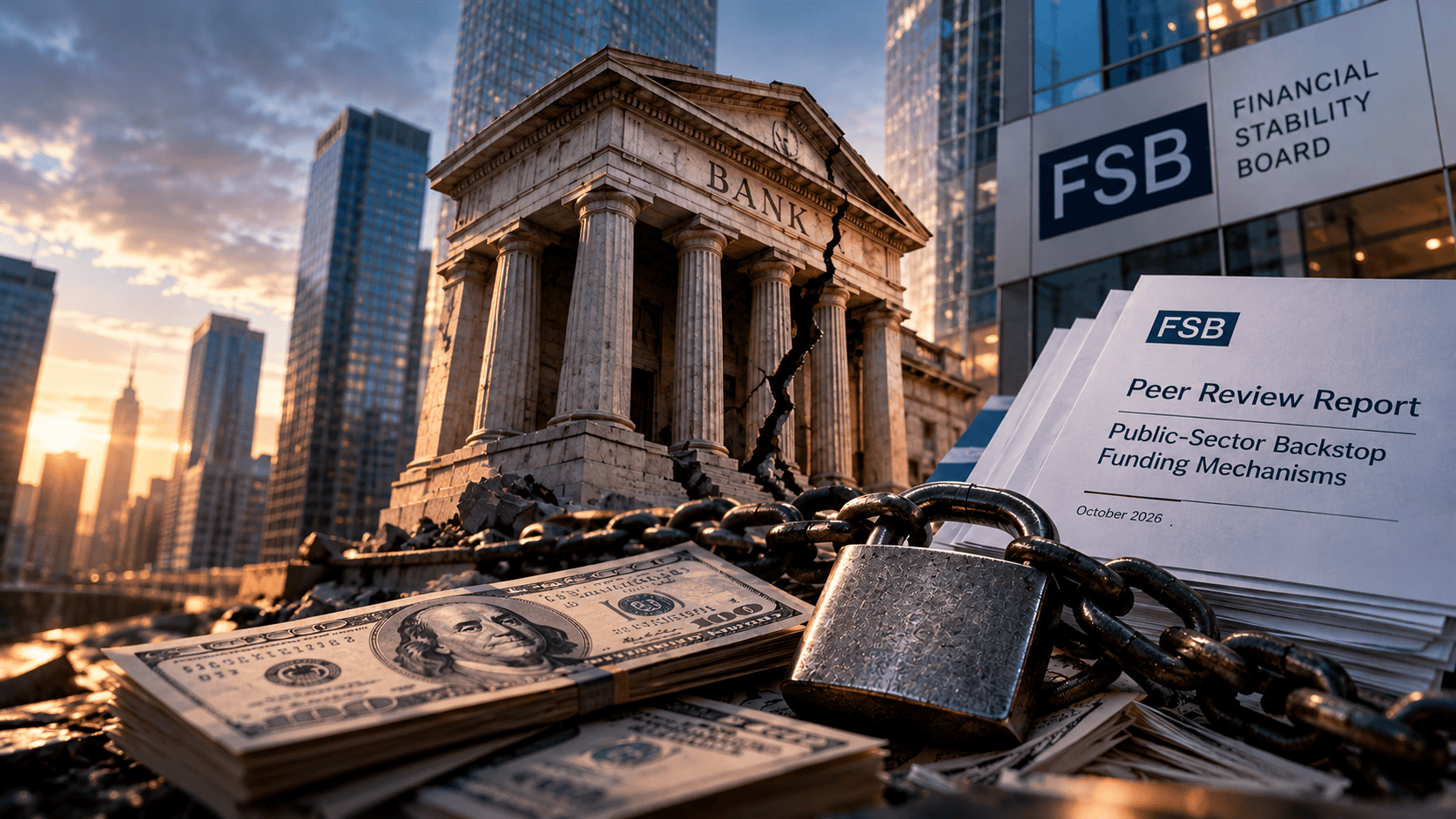
The FSB finds major gaps in emergency funding frameworks, exposing a critical weakness in the post-2008 bank resolution system.
A failed bank can absorb losses, recapitalise through a bail-in and still run out of cash. That is the central weakness exposed by the Financial Stability Board's (FSB) latest review of public-sector backstop funding.
Published on 9 October 2026, the review finds that only four of 19 assessed jurisdictions fully comply with international standards for funding systemic banks through resolution. Fewer than half have mechanisms that are sufficiently clear, scalable and operationally ready. The four fully compliant jurisdictions are Hong Kong, Japan, the United Kingdom and the United States.
The findings do not signal an imminent banking crisis. They identify a structural gap in the financial safety net: resolving a bank's capital shortfall does not necessarily restore the liquidity needed to meet withdrawals, settle payments and maintain critical operations.
FSB review exposes gaps in bank resolution liquidity
The FSB assessed 19 jurisdictions against Key Attribute 6 of its post-crisis resolution framework. The standard requires authorities to establish credible access to temporary public funding when a failing bank cannot obtain sufficient liquidity from its own resources, private markets or ordinary central-bank facilities.
Such funding is intended as a last-resort bridge, not a mechanism to protect shareholders from losses. A bank may emerge from bail-in with a stronger balance sheet but remain unable to fund deposit withdrawals or market obligations while confidence is being restored.
Without a credible liquidity backstop, authorities risk facing a choice between disorderly liquidation and an improvised government rescue.
The FSB found that most jurisdictions remain materially non-compliant or non-compliant with the overall standard. Argentina and India were rated non-compliant, while Australia, China, the European Banking Union and Switzerland were among those rated materially non-compliant.
The review also identified shortcomings in arrangements for recovering residual losses from the financial industry, leaving potential exposure for taxpayers.
Why bank resolution funding differs across jurisdictions
The FSB's findings show that the problem is not simply whether emergency funding facilities exist. Their scale, legal authority, operational readiness and loss-recovery provisions determine whether they can function during a systemic crisis.
Australia: Funding tools exist, but loss recovery remains incomplete
Australia has several mechanisms that could support a failing bank, including exceptional liquidity assistance from the Reserve Bank of Australia, the Financial Claims Scheme and the Treasury's Financial System Stability Special Account.
The special account is subject to an A$20 billion limit per authorisation. Although the FSB assessed Australia's overall funding credibility as largely compliant, it rated the country's loss-recovery and moral-hazard safeguards materially non-compliant.
The review found no pre-arranged legal mechanism allowing the Reserve Bank or the special account to recover residual losses across the wider financial sector. It also identified the absence of a fixed statutory loss-allocation waterfall.
The distinction is important: access to emergency funding does not necessarily establish who ultimately bears the cost.
European Banking Union: The challenge is systemic scale
The European Banking Union was rated materially non-compliant because its Single Resolution Fund and borrowing arrangements have limited flexibility relative to the size of the banking system, which includes seven global systemically important banks.
The FSB assessed operational readiness, loss recovery and moral-hazard safeguards as compliant. However, the agreed European Stability Mechanism common backstop had not been ratified by the review's cut-off date.
The principal weakness is therefore the availability of funding at sufficient scale, rather than the absence of a resolution framework.
China: Operational readiness remains a constraint
China was rated materially non-compliant, with the FSB identifying limited funding flexibility and weak operational readiness.
Key resolution funding arrangements had not reached their target capacity, central-bank relending mechanisms had not been operationalised, and coordination protocols between authorities remained incomplete.
These weaknesses highlight the difference between establishing a funding mechanism and demonstrating that it can operate during a crisis.
Switzerland: Crisis intervention is not a permanent backstop
Switzerland's experience following the 2023 Credit Suisse rescue provides another example.
Emergency measures helped stabilise the situation, but the FSB still rated the country's standing framework materially non-compliant on scalable resolution funding.
The lesson is not that emergency intervention cannot work. It is that successful crisis improvisation does not replace legally established, pre-positioned funding capacity.
Why bank resolution liquidity matters for investors
The FSB review does not directly change bank capital requirements, credit ratings or resolution laws. Its significance lies in how investors assess the risks embedded in bank liabilities and funding structures.
Bail-in debt cannot replace liquidity
Additional Tier 1 instruments and other loss-absorbing liabilities can help recapitalise a failing bank by imposing losses on investors. They do not, however, generate the cash needed to meet withdrawals and settlement obligations.
Capital adequacy and liquidity availability are separate questions. A bank may have sufficient post-resolution capital while remaining vulnerable to a funding run.
For bank-credit investors, this distinction makes the credibility of resolution funding an important component of downside analysis.
Sovereign capacity becomes part of bank-credit risk
A credible public-sector liquidity backstop requires more than legal authority. It also depends on available fiscal resources, operational readiness and mechanisms for recovering losses.
Where those arrangements are weak, banking stress can place additional pressure on sovereign finances. Sovereign funding concerns can, in turn, undermine confidence in the banking system.
Investors therefore need to evaluate both the bank's own funding model and the institutional framework supporting its resolution.
Private credit remains exposed to banking liquidity shocks
Bank retrenchment can create lending opportunities for private credit managers, particularly when regulated lenders reduce balance-sheet exposure.
That does not make private credit independent of the banking system. Private funds rely on banks for subscription credit facilities, net asset value financing, warehouse lines, derivatives and payment infrastructure.
A disruption to bank resolution liquidity could simultaneously tighten financing for private lenders and increase the cost of credit across private markets.
The implication is not that investors should automatically avoid particular jurisdictions. It is that bank-credit spreads and private-market financing structures should be assessed against the credibility of the relevant liquidity backstops.
Cross-border liquidity creates additional resolution risks
The FSB review did not formally assess foreign-currency liquidity or the full complexity of cross-border resolution coordination. These remain important limitations of its jurisdictional scorecard.
A global bank may need access to dollars, euros, sterling and yen across several subsidiaries during the same crisis. If host-country regulators lack confidence in the home authority's ability to deliver liquidity, they may restrict the movement of collateral or funding across borders.
Such ring-fencing could fragment a banking group precisely when its resolution strategy depends on centralised loss absorption and coordinated liquidity distribution.
There is also a policy trade-off. A credible public backstop can reduce the risk of destabilising withdrawals, but an apparently unconditional guarantee can encourage excessive risk-taking.
The stronger framework is one that establishes funding conditions before a crisis, including loss allocation, collateral requirements, industry recovery mechanisms and transparent decision-making.
What investors should watch in the FSB resolution framework
The FSB's findings point to six practical tests for assessing bank resolution funding: clearly identified funding sources, sufficient capacity for systemic institutions, operational readiness under crisis timelines, enforceable loss-recovery arrangements, safeguards against moral hazard and credible cross-border liquidity coordination.
Implementation will vary by jurisdiction.
In Australia, the priority is whether authorities strengthen statutory loss recovery and clarify the allocation of costs associated with exceptional liquidity support. In Europe, the decisive issue is the legal and operational availability of the common backstop. In China, investors should watch whether funding capacity and central-bank relending arrangements become operational and demonstrably effective.
Across markets, bank earnings and regulatory capital disclosures should be considered alongside the resilience of the wider resolution framework.
Manhattan view: A bail-in is not a funding plan
The post-2008 regulatory system has focused heavily on ensuring that banks can absorb losses without relying on taxpayer-funded recapitalisation. The FSB's latest review highlights the unresolved second question: whether authorities can provide enough cash to keep a restructured bank operating.
The review does not conclude that the global banking system is approaching failure. It shows that many jurisdictions remain insufficiently prepared for the period between imposing losses and restoring market confidence.
That gap matters because liquidity stress can accelerate withdrawals, force asset sales, transmit pressure into sovereign funding markets and disrupt the financing structures supporting private credit.
Investors should distinguish jurisdictions with pre-arranged, scalable and tested resolution funding from those still dependent on limited facilities or emergency discretion.
Structure first. A bail-in is not a funding plan.
Sources
- Financial Stability Board — Thematic review on public-sector backstop funding mechanisms
- Financial Stability Board — Full peer review report
- Reuters — Global watchdog urges authorities to close funding gaps
- Financial Times — Most countries unprepared for bank failures
This publication is for general financial information only and does not constitute investment, legal, tax or financial advice. Private-market and bank-credit investments involve risk, illiquidity and potential loss of capital.