
Private Credit Strategies and Capital Protected Structured Notes
Most investors still play by an old rulebook: park capital in broad markets, wait, and hope.
That model worked when drawdowns were slower, information moved less efficiently, and institutions weren’t aggressively engineering their risk exposures.
Today, patience alone is not the conservative choice.
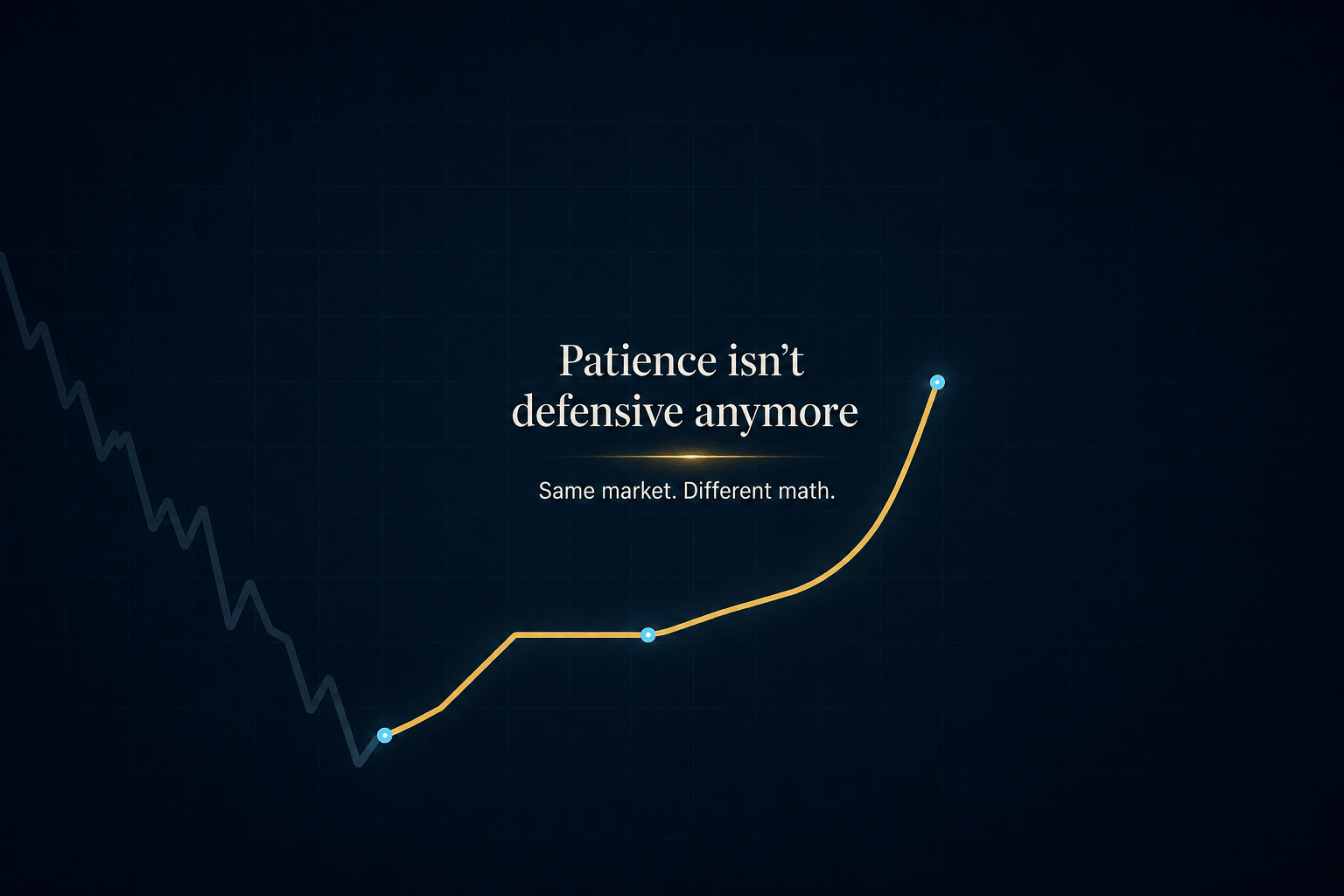
This is where capital protected structured notes come in: tools institutions use to stay largely flat through drawdowns while still participating in the recovery.
Alongside disciplined private credit strategies, these structures can give sophisticated investors another way to reduce dependence on long-only public market beta while keeping capital productive.
If you’re sitting on meaningful idle capital — or watching your “defensive” portfolio fall in lockstep with the S&P — this is the problem to solve.
The Old Model Is Broken: Why “Park and Pray” Fails in Modern Markets
Why patience is no longer the conservative choice
For decades, the default advice was simple:
- Own a diversified basket of equities.
- Add some bonds.
- Sit still and wait.
In a world of lower volatility, higher real yields, and fewer structural shocks, that was often good enough.
But the market you’re operating in now is different:
- Information and flows move at machine speed.
- Policy regimes change faster.
- Event risk is constant, not occasional.
In that environment, being fully exposed on the way down and fully exposed on the way up is not conservative. It’s blunt.
Conservative capital today asks a sharper question:
How do I define my maximum drawdown in advance while keeping exposure to upside if I’m right about the long term?
How volatility punishes unprotected capital
When the S&P sells off 15–20%, unstructured exposure behaves exactly as you would expect: it goes down with the index.
You then face two unattractive choices:
- Realize the loss and move to cash, locking in damage.
- Stay fully invested and hope the recovery timeline matches your liquidity needs.
Neither of these is an institutional answer.
Institutions don’t rely on hope. They rely on positioning.
What Are Capital Protected Structured Notes?
Core mechanics in plain English
Capital protected structured notes are pre-engineered payoff profiles.
Instead of owning an index or stock directly, you own a contract that says, in effect:
- If the underlying asset is flat or modestly down, you get your capital back.
- If the underlying recovers or rises, you participate in a defined share of that upside.
- Your downside, within specified conditions, is limited or fully protected.
The details vary by structure, but the intent is consistent: shape the path of returns, instead of accepting whatever the market gives you day by day.
The building blocks are familiar to institutions:
- A capital-protective component (often bond-like).
- An options-based component that provides conditional participation in upside.
The result is a structure where drawdowns are constrained by design, rather than left entirely to market forces.
Where structured notes sit in a modern portfolio
Capital protected structured notes are not a replacement for an entire portfolio. They are a tool inside it.
Sophisticated allocators use them to:
- Put sidelined cash to work without taking full equity risk.
- Replace part of their long-only equity exposure with asymmetric upside and defined downside.
- Express views around macro events and volatility with more precision.
They sit at the intersection of:
- Risk management (protecting principal), and
- Opportunity capture (staying exposed to rebounds and structural trends).
How Capital Protected Structured Notes Create Asymmetric Upside
Staying flat in drawdowns
The core appeal is straightforward: in periods of market stress, a well-structured capital protected note is designed to stay close to flat while traditional equity exposure is falling.
That doesn’t mean every note is immune to all losses. It means the payoff is engineered so that, within agreed parameters, your principal is protected even if the underlying index is down.
This is the opposite of the “fully naked” position many portfolios hold by default.
Participating in the recovery
The second half of the story is what happens after the drawdown.
A structured note can be built so that, when the market stabilizes and moves higher, you capture a defined portion of that recovery.
In practical terms, this can look like:
- Flat to modestly positive performance during a selloff, and
- Participation in gains as the index rebounds.
That profile — limited pain on the way down, meaningful participation on the way up — is why institutions have used structured capital solutions for years.
Why this is the math institutions play with
Institutions are not only chasing raw returns. They care about:
- Maximum drawdown.
- Volatility of the path.
- Predictability of outcomes.
Capital protected structured notes allow them to work with constrained distributions of outcomes, not open-ended ones.
This is the “math” you rarely see discussed in retail channels, but it’s central to how sophisticated capital compounds:
- Avoid large, damaging drawdowns.
- Keep a claim on future upside.
- Let time and structure do more of the work than emotion and timing.
A Simple Scenario: S&P Drawdown vs Structured Note Portfolio
To ground this, imagine two approaches during a quarter where the S&P sells off and then recovers.
What happens to unstructured equity exposure
Portfolio A holds only the S&P via a broad index fund:
- The S&P drops sharply.
- The portfolio falls point-for-point with the index.
- When the rebound starts, you still have to climb out of the hole.
You end the period wherever the index ends — but you absorbed the full volatility along the way.
What happens to a capital protected structured note
Portfolio B allocates part of its equity exposure to a capital protected structured note linked to the same index.
Through the drawdown, that portion of the portfolio is designed to:
- Hold close to flat within the protection parameters, rather than mirror the full decline.
When the market recovers:
- That capital is already at or near par.
- It participates in gains according to the structure’s terms.
The difference is not about predicting the market more accurately. It is about entering the same market with a different payoff profile.
That is the edge structured capital can provide: not superior foresight, but superior structuring.
Who Should Consider Capital Protected Structured Notes?
Typical profiles: from operators to family offices
Capital protected structured notes are not designed for every investor. They tend to fit:
- Accredited investors and founders with meaningful liquidity events who want to stay exposed to growth without re-living 2008 or 2020-level drawdowns.
- Operators and macro-aware professionals who understand regime risk and want tools that behave rationally across cycles.
- Family offices and wealth platforms looking to institutionalize risk management beyond simple diversification.
In all cases, the common thread is a preference for defined downside and disciplined upside, rather than binary risk-on / risk-off decisions.
When idle or exposed capital is a real problem
If you recognize yourself in any of these situations, structured capital solutions may be relevant:
- You are sitting on significant idle cash because you don’t trust public markets at current levels.
- Your “conservative” portfolio falls in line with the S&P whenever there is stress.
- You know institutions use different tools but haven’t translated those tools into your own allocation.
The problem is not a lack of opportunity. The problem is lack of structure around how your capital participates.
Key Risks and Misconceptions Around Structured Capital Solutions
What capital protection does and does not mean
"Capital protected" is a technical statement, not a promise that nothing can go wrong.
Protection typically depends on:
- Issuer credit: if the institution behind the note fails, protection can be impaired.
- Terms and barriers: most structures protect capital within defined conditions. Move outside those, and losses are possible.
It’s critical to understand:
- What scenarios are explicitly protected.
- What scenarios are not.
Institutional allocators read the term sheet as carefully as they read the headline return.
Liquidity, complexity, and issuer risk
Capital protected structured notes come with trade-offs:
- Liquidity: Many structures are designed to be held to maturity. Interim liquidity may be limited or available only at a discount.
- Complexity: The payoff is more complex than a single line item on a brokerage statement. You need to be comfortable with the terms or work with someone who is.
- Issuer risk: You are exposed to the creditworthiness of the issuing institution. This is part of the risk stack, not an afterthought.
These are not reasons to ignore structured capital. They are reasons to treat it as an institutional instrument — to be used with clear intent, documentation, and governance.
How Private Credit Strategies Fit With Structured Capital
Event-driven, downside-first architecture
At Manhattan Private Credit, we approach structured capital as architecture, not product.
The focus is simple:
- Start with the drawdown profile we are willing to accept.
- Design structures that protect capital through stress while preserving asymmetric upside.
- Use these tools around key macro and event-driven inflection points.
We are less interested in chasing every rally and more interested in compounding from a higher floor.
That same downside-first philosophy can also inform private credit strategies, where contractual cash flows, capital structure priority, covenants, and underwriting discipline can provide a different return profile from long-only public market exposure.
Next steps if you are sitting on extra capital
If you are:
- An accredited investor,
- Sitting on idle or underperforming capital, and
- Aware that institutions are playing a more advanced game than "park and hope",
then it may be time to look seriously at structured capital solutions, including capital protected structured notes.
For some portfolios, combining structured capital with carefully selected private credit strategies can create multiple defensive return engines rather than relying on a single source of public-market beta.
This is not about prediction. It is about positioning your capital to behave intelligently when markets don’t.
Learn more at manhattanprivatecredit.100xmedia.agency.
Join the network. Start upgrading the tools your capital uses.
FAQ: Private Credit Strategies and Capital Protected Notes
What are capital protected structured notes in simple terms?
Capital protected structured notes are pre-engineered investment contracts designed to limit or fully protect principal against market drawdowns, while still offering exposure to the upside of an underlying asset or index. Instead of owning the asset outright, you hold a structure whose payoff profile has been shaped to prioritize downside protection with defined participation in gains.
Are capital protected structured notes actually safe?
They can be defensive, but they are not risk-free. Capital protection typically depends on the creditworthiness of the issuer and the specific terms of the structure. You are trading some liquidity and simplicity for precision around downside and upside. Institutional investors use these tools inside a broader risk framework, not as a shortcut to guaranteed returns.
Why would I use structured notes instead of just holding cash during volatility?
Cash is safe, but it does not participate in recoveries and can be eroded by inflation and opportunity cost. Capital protected structured notes are designed to keep you in the game: they aim to limit drawdowns while maintaining exposure to upside so you are positioned for the rebound rather than trying to time your way back into risk assets.
Who are capital protected structured notes suitable for?
They are typically used by institutional investors, family offices, and accredited or high-net-worth investors who have material capital to deploy, care deeply about drawdown control, and want more precise payoff profiles than simple long-only equity or bond exposure can offer.
How do structured capital solutions fit with private credit strategies?
For some investors, structured credit and private credit allocations can sit alongside capital protected structured notes as part of a broader downside-first portfolio. Private credit strategies can target contractual cash flows, while structured capital solutions can shape equity or index-linked exposure with defined downside limits. Both can be tools for reducing reliance on traditional public market beta.
Learn more at manhattanprivatecredit.com.