
Private Credit Strategies for Disciplined Investing in Market Stress
Redemptions and outflows always dominate the screen. They’re simple to explain and easy to sensationalize.
But disciplined private credit strategies don’t trade headlines. They watch where capital is still quietly deploying, on what terms, and at what yields.
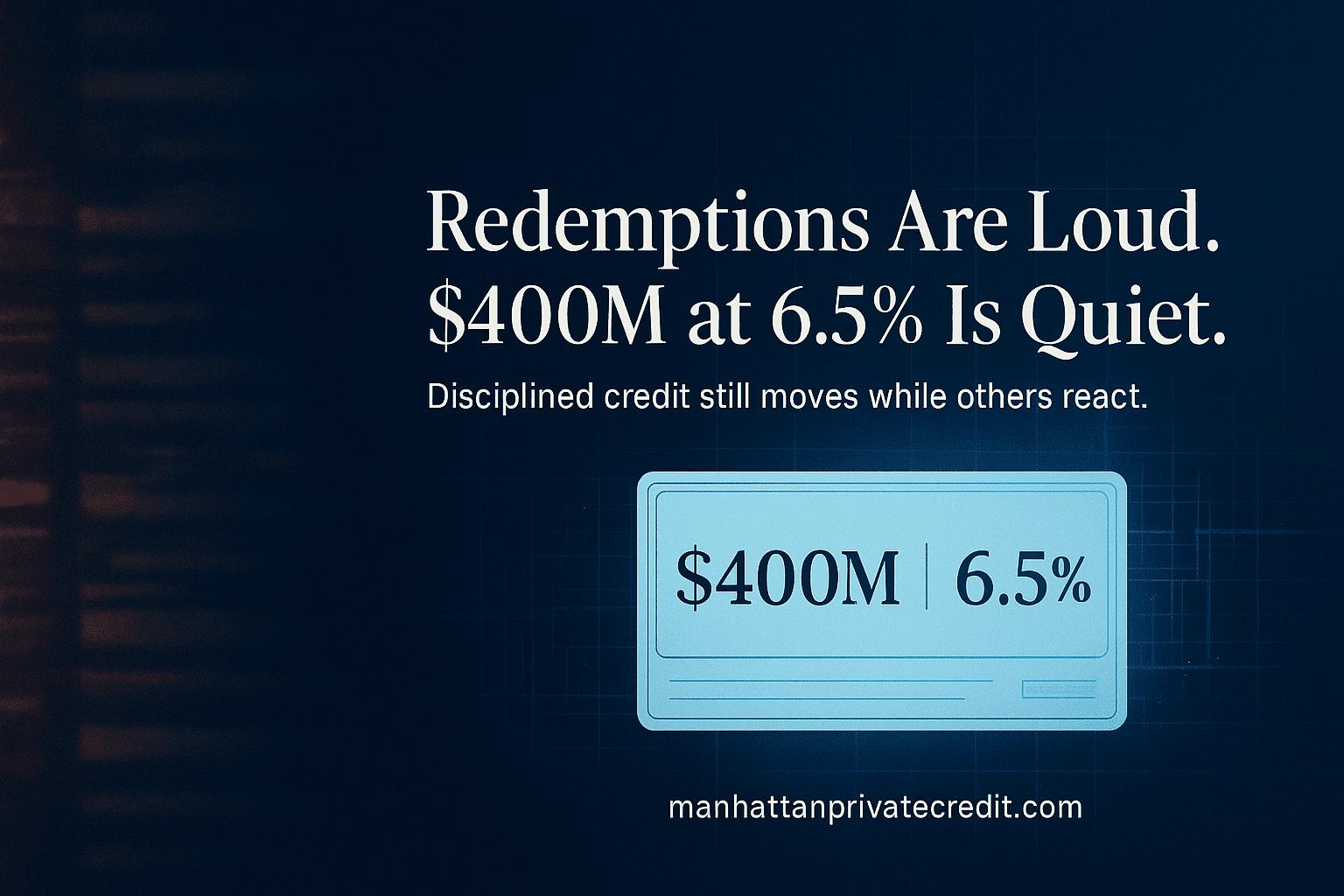
This week, while the narrative focused on outflows, Blue Owl closed a $400 million bond deal at 6.5%, the first of its kind in over a month.
That’s not what panic looks like. That’s a market repricing risk.
The Gap Between Headlines and Private Credit Strategies
When volatility spikes, most investors ask the wrong first question: “Are credit markets breaking?”
The better question for a disciplined credit investor is simpler:
“At what price is real capital still willing to take risk?”
Why redemptions dominate the narrative
Redemptions are visible and emotional:
- They create sharp price moves.
- They show up in fund flow charts.
- They fit an intuitive story about fear.
That makes them irresistible for headlines. But flows are only one part of the picture. They often tell you who is under pressure—not whether the underlying credit is fundamentally mispriced.
Redemptions can be driven by:
- Asset allocation shifts at large institutions.
- De-risking mandates after drawdowns.
- Liquidity needs unrelated to credit quality.
None of those automatically mean markets are broken. They mean some investors are forced to sell at the wrong time.
What institutional credit investors actually watch
Disciplined, institutional credit investors rarely anchor on flow data alone. They focus on:
- Primary issuance: Are new deals still getting priced and placed?
- Spread levels: How much are investors being paid to take incremental risk?
- Structure and terms: Are covenants tightening? Are lenders pushing for better protections?
- Real-money participation: Which allocators are actually buying these deals?
In that framework, a $400M bond at 6.5% in a “stressed” tape is not a curiosity. It’s a signal.
What a $400M Bond at 6.5% Really Tells You About Credit Markets
A bond deal of that size doesn’t price by accident.
It requires:
- Underwriters willing to risk their balance sheet.
- Real-money accounts willing to hold the paper.
- Agreement on a yield that compensates for current and forward-looking risk.
That’s exactly what happened with Blue Owl’s $400M bond at 6.5%.
Bond deals don’t get done in true panic
In a genuine credit freeze:
- Primary issuance stops.
- Syndicate desks go quiet.
- Buyers step back because they cannot price risk, not because they won’t.
If the market were truly seizing up, a $400M print simply wouldn’t clear. There would be no consensus on level, no depth of demand, and no appetite to underwrite.
The fact that this deal closed tells you something important:
The market isn’t collapsing. It’s repricing.
Pricing, not headlines, is the real signal
Panic doesn’t price a 6.5% bond. Discipline does.
For investors evaluating private credit strategies, the presence of a deal like this raises constructive questions:
- What risks are being priced into 6.5%?
- How does that yield compare to similar issuers and structures three or six months ago?
- Is the market overpaying for near-term fear, or correctly pricing deteriorating fundamentals?
The answers won’t come from a headline about outflows. They come from credit work, capital structure analysis, and context.
How Private Credit Strategies Behave in Stressed Markets
When screens are red, there are two broad playbooks:
- Tourist capital: sells because everyone else is selling, or buys because things “look cheap.”
- Disciplined capital: adjusts exposure only when price vs. risk has moved into attractive territory.
Disciplined private credit strategies live firmly in the second camp.
From “risk on / risk off” to “price vs. value”
Binary risk-on / risk-off thinking doesn’t work well in credit. The asset class is inherently about asymmetry and downside—not just volatility.
Disciplined investors ask:
- Has spread moved more than fundamentals have deteriorated?
- Are we being paid for liquidity risk, or for real default risk?
- Does the structure protect us if the macro base case is wrong?
If the answer is yes, volatility becomes a tool, not a threat.
Filtering out the tourists from the real capital
Stressed markets reveal who is:
- Over-levered.
- Mark-to-market sensitive.
- Constrained by daily liquidity promises.
Those are often the forced sellers.
Real credit capital tends to be:
- Longer-horizon.
- Less mark-to-market constrained.
- Willing to underwrite idiosyncratic and event-driven risk.
When tourist capital heads for the exit, disciplined investors don’t reflexively follow. They re-underwrite at new prices and selectively step in where the dislocation is driven by flows, not failure.
Where Sophisticated Capital Moves When Others Redeem
Outflows themselves are not an investment thesis. But they create conditions that disciplined credit investors can act on.
Outflows as forced sellers, not market failure
When redemptions spike:
- Funds must meet cash demands.
- Liquid holdings get sold first.
- Prices of otherwise sound credits can gap lower.
That doesn’t mean the issuer’s ability to pay has suddenly collapsed. It often means the owner’s need for liquidity has spiked.
Disciplined credit investing looks for:
- Credits sold for structural or mandate reasons rather than true impairment.
- Misalignments between trading levels and underlying cash flows.
- Capital structures where one part is being liquidated indiscriminately.
Targeting windows created by redemptions
These forced selling dynamics can create entry points for:
- Event-driven credit trades.
- Private credit financings stepping into bank or market gaps.
- Opportunistic refinancings at yields that would have been impossible months earlier.
That’s precisely where specialized lenders and private credit platforms with ready, committed capital can move while others are crowding the exits.
Positioning Your Portfolio With Private Credit Strategies
For accredited investors and macro-aware operators, the question is not whether volatility is uncomfortable. It’s whether you’re positioned to use it intelligently.
Questions to ask before deploying into volatility
Before adding risk in stressed credit markets, disciplined investors typically run through questions like:
- What is the true source of the dislocation—fund flows, rates, idiosyncratic risk, or structural change?
- How does today’s yield compare to long-term compensation for similar risk?
- What’s my downside case, and does the current spread offer a real margin of safety?
- Am I taking liquidity risk I can actually afford, or one I’ll regret at the next headline?
If those answers are unclear, standing aside is not cowardice. It’s discipline.
Why access and timing matter more than headlines
You don’t get paid for reading the same headlines as everyone else. You get paid for:
- Having access to deals and structures that tourists can’t touch.
- Deploying capital when the pricing window is open, not months later when the narrative has turned.
- Aligning with managers who are willing to be selective, patient, and occasionally contrarian.
That is the core of disciplined private credit strategies in volatile markets: not blind aggression, not fear-driven retreat—calculated deployment when capital is being overpaid for taking rational risk.
FAQ: Private Credit Strategies in Volatile Markets
If headlines say credit markets are stressed, why are new bonds still getting done?
Because stress is not the same as breakdown. In a true freeze, primary issuance shuts down—no one can agree on price. When a $400M bond clears at 6.5%, it signals that buyers and sellers are still meeting, spreads are widening to compensate for risk, and institutional capital is willing to deploy at the right level. That is a functioning market repricing risk, not a broken one.
What does a bond like Blue Owl’s $400M deal at 6.5% signal to disciplined credit investors?
It signals that sophisticated capital is still active, but more selective. Deals of that size don’t get done in blind panic. They get done when underwriters and institutional buyers are comfortable that the spread compensates them for current and expected risk. For disciplined investors, that type of pricing is the starting point for underwriting, not a reason to hide in cash.
How should accredited investors think about redemptions and outflows in credit funds?
Redemptions are often more about liquidity needs, risk-budget resets, or mandate constraints than a fundamental collapse in credit. Forced selling can pressure prices and widen spreads in the near term, which is painful if you have to sell but interesting if you are a patient buyer. The key is to distinguish flows-driven moves from genuine credit impairment—and position on the other side when the math works.
What defines disciplined private credit strategies in volatile markets?
Disciplined private credit strategies start with underwriting, not headlines. They mean sizing risk to realistic downside scenarios, insisting on structure and covenants where possible, and demanding spreads that compensate for both known and unknown risks. They avoid binary macro bets and focus instead on specific capital structures, counterparties, and events where mispricing is most likely to emerge under stress.
Why consider private credit when public credit markets are volatile?
Public markets transmit fear quickly through screens and ETFs, often overshooting in both directions. Private credit can be slower-moving, more negotiated, and more focused on underlying cash flows and collateral than daily mark-to-market. In periods of public volatility, private lenders with committed capital can step into gaps created by banks, redemptions, or rating constraints and demand stronger terms and yields.
How does timing matter for disciplined credit deployment?
Most investors either rush in too early, before spreads have reset, or too late, after the best risk-adjusted returns have been taken. Disciplined timing means waiting for genuine price discovery—wider spreads, tighter structures, better covenants—then leaning in selectively while others are still reacting to old headlines. It’s less about calling the bottom and more about insisting on pricing that builds in a margin of safety.
How Manhattan Private Credit Approaches Disciplined Deployment
At Manhattan Private Credit, our approach to private credit strategies centers on where disciplined capital can move when the tape turns noisy:
- We focus on event-driven and private credit opportunities where volatility creates terms, not just fear.
- We look for dislocations driven by redemptions and structural constraints rather than true credit collapse.
- We connect qualified investors to institutional-grade credit deployment when the market has just opened a window.
If you’re an accredited investor or operator looking to allocate beyond the headline narrative, this is the moment to tighten your filter, not your circle.
Learn more at manhattanprivatecredit.com and join the network if you want to be in the flow of disciplined credit opportunities the next time the headlines scream panic.