
India Private Credit Strategies for Owning Origination Rails
India’s credit boom is obvious. The real trade inside it is not.
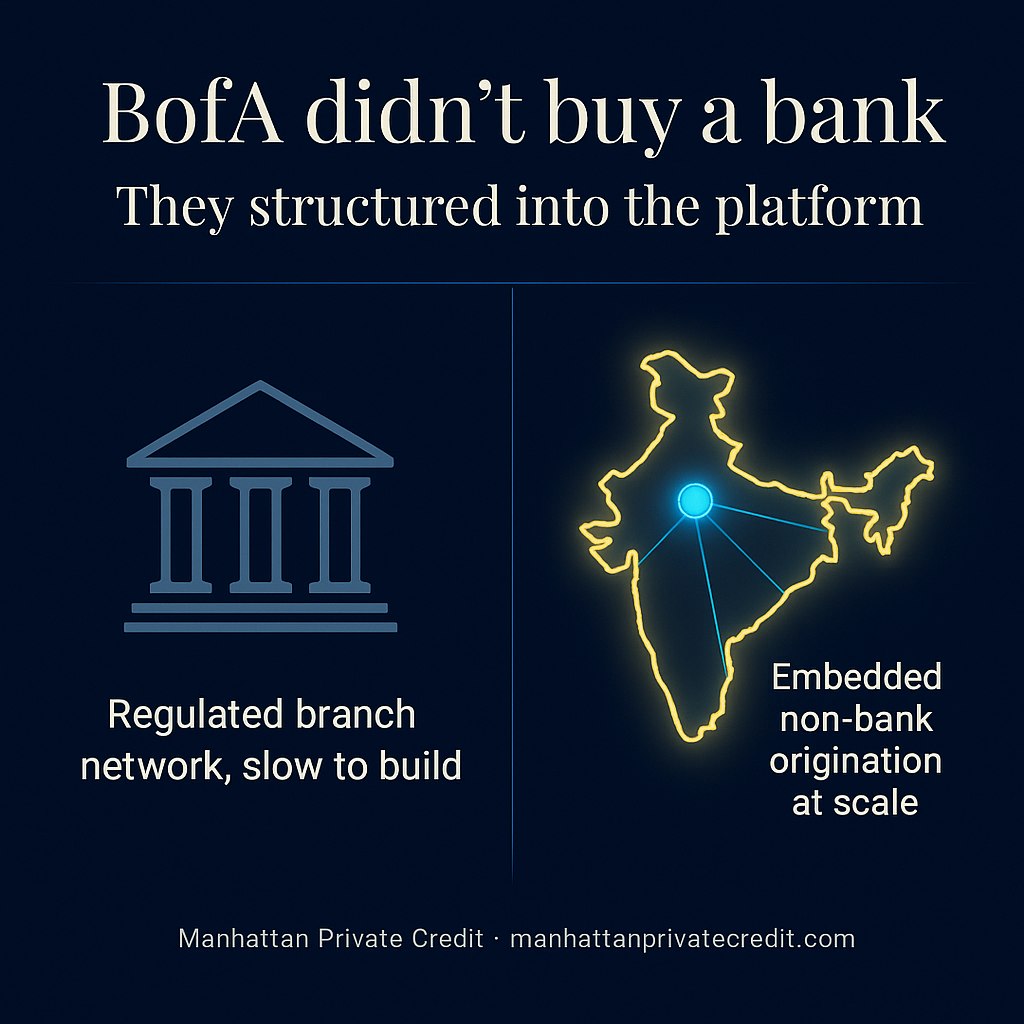
Most investors approach private credit strategies in India by buying banks or writing generic loans into NBFCs. Bank of America’s move into Jio Credit points to a different answer: own the rails of origination, not just the balance sheet behind it.
Why Private Credit Strategies in India Go Beyond Banks vs NBFCs
The obvious trade: chase Indian credit growth via banks
The macro story is straightforward:
- Rising incomes and formalisation
- Digitised payments and identity rails
- Under-penetrated consumer and SME credit
That naturally pulls capital into:
- Large private-sector banks
- Public-sector banks post-cleanup
- Listed and unlisted NBFCs offering higher-yield credit
For most allocators, the question becomes: Which banks? Which NBFCs? What mix of secured vs unsecured?
That’s the surface trade within many private credit strategies in India: you decide where on the risk curve you want to sit, then you underwrite the lender’s book, capital adequacy, and governance.
The structural risk: owning the wrong side of the value chain
The deeper question is different: Who actually controls access to the borrower and the flow of information?
In a digitising economy, that control increasingly sits with:
- Ecosystem platforms (telco, e-commerce, payments, super-apps)
- Embedded finance rails inside large consumer networks
- Local non-bank platforms that sit between global capital and end-borrowers
If you own the balance sheet but not the origination rails, you are:
- Competing on price in a crowded market
- Dependent on other people’s data and distribution
- Slow to adapt product and risk models to real-time behaviour
That’s the structural risk in treating India private credit as a bank stock screen. The capital is interchangeable. The rails are not.
Inside the Bank of America–Jio Credit Deal
A live transaction makes the shift visible.
Bank of America has agreed to invest up to ₹18,268 crore (≈ $1.9 billion) in Jio Credit, the non-bank lending subsidiary of Jio Financial Services. The deal is still subject to regulatory and statutory approvals.
Key terms: size, structure, and ownership path
The structure matters more than the headline number:
- Instrument: equity and warrants in Jio Credit
- Initial stake: 26.5% equity interest
- Path to control-adjacent: up to 49.9% ownership if warrants are exercised
This is not a passive funding line. It is not a vanilla JV to originate loans that sit on BofA’s balance sheet.
It is a deliberate equity position in the non-bank platform that controls origination and customer reach.
What the equity-and-warrants structure really says
The structure tells you how Bank of America sees the opportunity:
- It wants meaningful economic exposure to the platform, not just the loan book.
- It values the optionality to scale its stake up to 49.9% as the platform proves out.
- It is comfortable letting local infrastructure and brand sit at the edge, while it brings global balance-sheet capacity and capabilities behind the scenes.
In other words, BofA is not trying to build an American-style consumer bank in India. It is plugging into a local origination engine that already sits in the flow of Indian consumer behaviour.
Why Origination Platforms Matter to Private Credit Strategies
Origination vs balance sheet: who actually controls the economics?
In any lending system, there are three distinct functions:
- Origination – finding, underwriting, and onboarding the borrower
- Servicing – collecting, monitoring, and managing the relationship
- Funding – providing the capital and managing the liability side
Traditional banks bundle all three. Embedded platforms increasingly specialise in the first two.
In India’s digital ecosystem, that specialisation matters because:
- Platforms sit on behavioural and transactional data long before a loan is issued.
- They can embed credit at the point of need – inside a telco app, commerce checkout, or financial super-app.
- They can allocate flow to multiple funding partners, playing lenders off against each other.
When a platform controls origination and servicing, it can:
- Dictate which balance sheet gets access to what borrower segment
- Capture a structural take rate on credit economics
- Maintain flexibility as regulation, rates, and risk appetites change
The lender’s ROE is then a function of how competitive it is on price and how efficiently it can fund. The platform’s economics are a function of volume, data, and switching power.
In that world, owning only the lending book is owning the commodity part of the stack.
Local reach, global capital: pairing the two without operational drag
Jio Credit sits in a unique position:
- It is locally embedded in one of India’s largest consumer ecosystems.
- It can originate at digital scale, leveraging telecom and digital-distribution rails.
- It operates as a non-bank lending platform, not a legacy retail branch network.
Bank of America brings:
- Global balance-sheet depth
- Risk management and structuring expertise
- Cross-border client relationships that may want exposure to Indian credit
The pairing is telling for investors developing private credit strategies around India:
- Global capital no longer needs to build a bank from zero to access the borrower.
- Local platforms do not need to become fully-fledged banks to scale lending.
- Equity in the platform, plus structured funding, can be more attractive than owning a generic lender outright.
The real asset is the rail that matches local origination with global balance sheets.
How Global Banks Are Rewriting Private Credit Strategies in India
Why building a retail bank from scratch no longer makes sense
There was a time when the default foreign strategy was: apply for a license, open branches, build a brand.
In today’s India, that approach carries heavy friction:
- Regulatory capital and compliance requirements suited to full-service banks
- Long timelines to build local trust and distribution
- Structural disadvantage against domestic platforms with embedded data and network effects
At the same time, global banks are under pressure to:
- Deploy balance sheets into higher-growth, higher-margin assets
- Avoid building complex local infrastructures that dilute returns
- Stay within risk, conduct, and compliance frameworks across jurisdictions
Owning or partnering with embedded origination platforms solves this equation more cleanly than owning yet another standalone retail bank.
Platforms as plug-and-play rails for institutional capital
The emerging model behind these private credit strategies looks like this:
- Local platforms: control origination, data, and customer interface.
- Global banks and private-credit funds: provide scalable funding, structuring, and risk tools.
- Flexible capital structures: equity, preferred equity, risk-sharing facilities, and forward-flow agreements layered around the same origination rail.
For allocators, this means:
- The core question is no longer, “Which bank do I own?”
- The question is, “Which platform’s rails am I sitting on, and how?”
Bank of America’s commitment to Jio Credit is a public marker of that shift.
A Practical Framework for Private Credit Strategies in India
If you manage serious capital and are problem-aware—i.e. you know India private credit is attractive but hard to access cleanly—your job is to avoid owning the wrong side of the value chain.
Questions to ask about any Indian lending exposure
When evaluating private credit strategies and Indian lending opportunities, start with these:
- Origination control
Who actually originates the loans? A captive branch network, a third-party DSA channel, or a platform with proprietary reach and data? - Data advantage
Does the platform see the borrower’s behaviour before the loan, or only after? Is data a moat or just a KYC form? - Funding flexibility
Can the platform allocate flow across multiple balance sheets, or is it tied to a single lender or warehouse line? - Regulatory posture
How is the platform positioned with regulators as a non-bank lender or embedded finance provider? Where could scrutiny intensify? - Alignment of incentives
Does the platform’s economics scale with loan performance, or only with volume? How is downside shared between platform and funding providers? - Path to structural ownership
Is there a credible way to own equity, warrants, or structured upside in the platform itself—not just a slice of the loan book?
If you cannot answer these, you are not underwriting a platform—you are guessing at a lending book.
What to look for in an embedded origination platform
For serious allocation into India private credit via platforms, look for:
- Embedded reach: integration into telco, commerce, or payments ecosystems where customers already transact.
- Modular architecture: the ability to plug multiple funding partners into the same rails without re-building the stack each time.
- Risk discipline: evidence that underwriting is driven by data and feedback loops, not just growth targets.
- Governance and rights: board representation, information rights, and protective terms that recognise your role as more than a commodity funding source.
- Scalable unit economics: contribution margins that improve with volume, not deteriorate under acquisition and servicing costs.
The aim is to own exposure to the rail itself—through equity, structured instruments, or both—alongside any credit exposure you underwrite.
FAQ on Private Credit Strategies and India’s Credit Boom
What makes India private credit structurally attractive right now?
India private credit sits on top of multi-year tailwinds: formalisation of the economy, digitised payments, under-penetrated consumer and SME credit, and a regulatory push toward cleaner bank balance sheets. The combination creates strong demand for lending capacity, but the most defensible economics increasingly accrue to the platforms that originate and distribute credit, rather than to plain-vanilla lenders competing on price.
Why focus on origination platforms instead of Indian banks or NBFCs?
Banks and traditional NBFCs are increasingly crowded, regulated, and capital-intensive ways to play Indian credit growth. Origination platforms control who gets access to the borrower, how data is captured, and how capital is matched. They can plug multiple balance sheets into the same rails and keep a structurally attractive share of the economics without owning the entire regulatory and operational burden of a full bank stack.
How does the Bank of America–Jio Credit deal illustrate this model?
Bank of America has agreed to invest up to ₹18,268 crore (about $1.9 billion) into Jio Credit, the non-bank lending arm of Jio Financial Services. The deal gives BofA an initial 26.5% equity stake via shares and warrants, with a path to 49.9% if warrants are exercised. Instead of building its own consumer lender in India, BofA is buying into a locally embedded origination and lending platform that already has reach, data, and distribution.
Is this approach only relevant for very large global banks?
No. Large banks validate the model, but the same logic applies to private-credit managers, family offices, and institutional allocators. You don’t need to own 49.9% of a platform; you do need to understand whether your capital is funding a commodity lending book, or sitting on rails where origination, data, and product design are defensible and scalable.
What are the main risks in backing embedded lending platforms in India?
Key risks include regulatory change around non-bank lending, consumer-protection scrutiny, platform concentration in a single ecosystem, and misaligned incentives between the origination platform and balance-sheet providers. The mitigation is disciplined structuring, governance rights, and a clear view on how the platform makes money in different credit and macro scenarios.
How can allocators build private credit strategies around Indian platforms?
Most allocators will access this theme through specialist managers, co-investments, or structured partnerships with local platforms. The priority is to diligence the origination model, data advantage, regulatory posture, and alignment with funding partners—not just top-line growth. Working with operators who are embedded locally and think in terms of capital structure rather than just loan volume is critical.
How Manhattan Private Credit Approaches Private Credit Strategies
At Manhattan Private Credit, we approach private credit strategies in India as a capital-structure and platform-design problem, not a stock-picking exercise.
We focus on:
- Event-driven and structural shifts—like the BofA–Jio Credit deal—that redefine who earns the spread.
- Locally embedded, non-bank platforms that control origination and can plug into global balance sheets without operational drag.
- Structures that give our network exposure to the rails, not just the latest loan vintage.
If you’re an accredited investor or operator thinking seriously about India’s credit build-out, your next question shouldn’t be, “Which bank?” It should be, “Which rails—and on what terms?”
Learn more at manhattanprivatecredit.com.