
How Private Credit Managers Use Secondaries for Liquidity at Scale
In private credit, liquidity often shows up precisely when it’s most expensive. The real mistake isn’t illiquidity itself. It’s designing a portfolio that can only sell the wrong 5% at the wrong time—when your peers are willing to recap the right 50% overnight.
The BlackRock TCP Capital Corp. (TCPC) transaction with a Pantheon-backed continuation vehicle is a clear signal: private credit secondaries are moving from clean-up trades to core balance-sheet strategy.
For private credit managers, the lesson is clear: secondaries can become a first-class portfolio-construction tool rather than an emergency exit.
Why Private Credit Secondaries Are Becoming a Core Liquidity Tool
The problem with traditional private credit liquidity options
Most private credit managers still rely on a familiar set of liquidity levers:
- Natural amortization and repayments
- Opportunistic refinancings
- Bilateral or club sales of individual loans
- Periodic syndications or participations
These tools work when:
- The book is relatively small
- Leverage is conservative
- Markets are benign
- You only need marginal liquidity
They fail when:
- A single sector or cohort dominates NAV
- Leverage is tight relative to covenants or market tolerance
- Public-market optics matter (for listed vehicles)
- You need balance-sheet relief at scale, not a few basis points of liquidity
In that world, selling 3–5% of a book doesn’t materially change anything. It just burns relationship capital and potentially signals distress.
From clean-up trade to balance-sheet strategy
Private credit secondaries change the scale and geometry of the problem.
Instead of:
- Selling a few troubled names piecemeal
Private credit managers can:
- Transfer a large, curated portfolio of loans into a dedicated structure
- Bring in a specialist secondary capital partner to underwrite the pool
- Use the transaction to reset leverage, reduce concentration, and redeploy capital
That’s the shift: from marginal, loan-by-loan liquidity to structured, portfolio-level recapitalizations.
The TCPC transaction is a live example of that shift playing out in public.
Inside the BlackRock TCP Capital Secondary: Liquidity by the Half-Book
What actually moved: scale, composition, and counterparties
BlackRock TCP Capital transferred a significant portion of its private credit portfolio into a continuation structure backed by Pantheon. Based on public reporting:
- Approximately $523 million of private loans were moved
- The portfolio covered roughly 78 companies
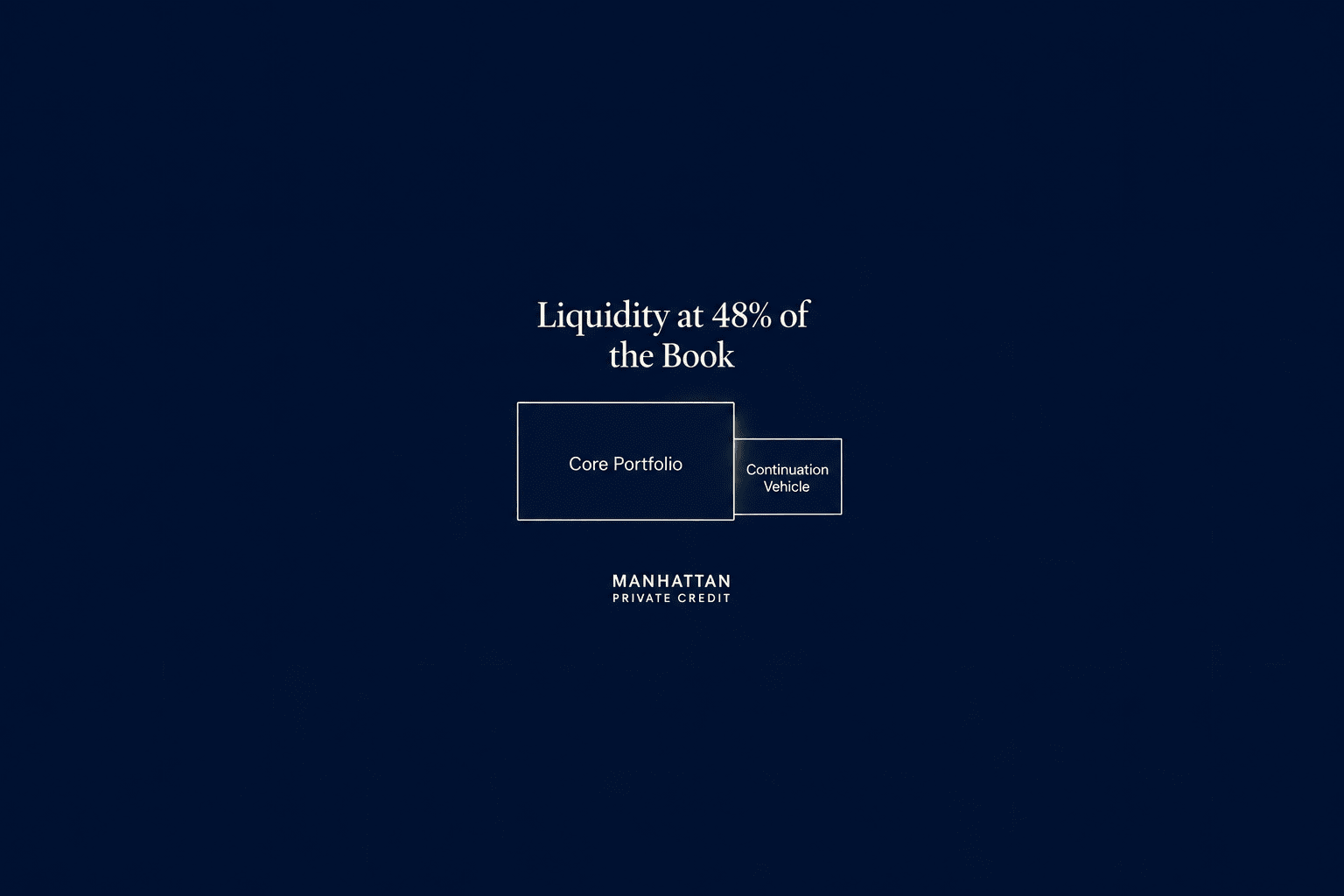
- The transfer represented about 48% of TCPC’s debt portfolio by fair value before the deal
On the equity side of the new vehicle:
- TCPC transferred 95% of the equity interests in the continuation vehicle
- TCPC retained a 5% equity stake, alongside direct investments described in the reporting
In other words, a publicly traded lender effectively moved nearly half its book into a new structure, with a new capital partner, while choosing to stay exposed on a minority basis.
Why this was a portfolio restructuring, not a rebalancing
When a manager shifts almost half its portfolio in a single transaction, that is not rebalancing at the margin. It’s a liquidity regime change.
This transaction allowed TCPC to:
- Generate liquidity against a large, diversified pool of assets
- Reset leverage at the corporate level by removing a material chunk of loans from its balance sheet
- Manage concentration across names, sectors, and structures
- Preserve economic exposure via a retained stake in the continuation vehicle
The key point: the scale did the work.
Selling 5% of the book would not have delivered the same leverage relief, risk reconstitution, or strategic flexibility. That’s the structural reality private credit managers and allocators need to internalize about private credit secondaries.
How Private Credit Secondaries Reset Leverage and Concentration
Using secondaries to reset leverage without fire sales
Traditional responses to leverage pressure in private credit include:
- Slowing new originations
- Letting cash build
- Opportunistic asset sales at discount levels
Each of these erodes some combination of returns, growth, or reputation.
Secondary transactions and continuation vehicles offer a different path:
- Transfer a large pool of loans into a new vehicle, at an agreed valuation
- Bring in secondary capital that is specifically mandated for these structures
- Use the proceeds to reduce debt, stabilize leverage metrics, or pursue new opportunities
The manager trades some future upside and control for:
- Immediate balance-sheet relief
- Cleaner leverage optics
- Potentially improved asset-liability matching
Instead of a visible, distressed-style liquidation of problematic names, you get a controlled, structured liquidity event across a whole portfolio slice.
Concentration management when 5% sales are too small to matter
Concentration risk in private credit is often discussed, but rarely addressed at scale. Selling a handful of names does little when:
- The top 20 positions dominate NAV
- Sector or structure exposure is clustered
- Correlations spike in stress scenarios
A private credit secondaries transaction allows a manager to:
- Identify a coherent cohort of loans (by vintage, sector, or risk profile)
- Move that entire cohort into a continuation structure
- Rebuild the on-balance-sheet portfolio with a different risk and sector mix
That’s a very different tool than trimming individual positions. It’s portfolio surgery, not cosmetic adjustment.
Continuation Vehicles as a Portfolio-Construction Engine
The 95/5 structure: liquidity with retained exposure
A critical detail in the TCPC transaction is the retained stake:
- 95% of the equity interests in the continuation vehicle were transferred
- 5% were retained by TCPC
This type of structure is important for two reasons:
- Alignment: Retaining a minority equity stake signals that the manager still believes in the underlying loans. They have downside and upside exposure alongside the new capital.
- Optionality: The manager can participate in any upside created through workouts, refinancings, or market normalization, without carrying the full balance-sheet weight of the loans.
In effect, the manager converts a large block of illiquid loans from a binary hold-or-sell decision into a structured participation via a continuation vehicle.
Planning for scale: when half the book needs a new wrapper
The key lesson from the TCPC example isn’t that every private credit manager should move 48% of their portfolio tomorrow. It’s that liquidity at scale requires premeditation.
Private credit managers should be asking:
- At what portfolio size or concentration level do bilateral sales stop being effective tools?
- What percentage of NAV would need to move to meaningfully change leverage and risk optics?
- How would a continuation-vehicle option change our approach to origination and sector exposure today?
Treat continuation vehicles as part of the original design of the capital structure, not as an improvisation when conditions deteriorate.
What This Means for Managers, LPs, and Public Credit Vehicles
For private credit managers: build a secondary playbook before you need it
Private credit managers should assume that at some point, private credit secondaries will be the only realistic way to achieve certain balance-sheet outcomes without destroying value.
That means:
- Mapping which parts of the book could logically sit in a continuation vehicle
- Understanding which secondary capital providers can underwrite those pools
- Stress-testing leverage and concentration metrics with and without a secondary option
- Preparing governance and communication frameworks for large-scale transfers
If the first time you model a 30–50% portfolio transfer is during a market dislocation, you’re already behind managers who have institutionalized this playbook.
For LPs and allocators: how to underwrite secondary-driven strategies
Allocators and accredited investors need to distinguish between:
- Reactive secondaries used to solve acute problems
- Strategic secondaries embedded in the portfolio design
Useful questions for diligence:
- How often does the manager anticipate using continuation vehicles?
- How do they decide which assets move and which stay?
- How are economics shared across existing LPs and new secondary investors?
- What stake does the manager or flagship vehicle retain in the continuation structure?
The TCPC–Pantheon example demonstrates that publicly traded vehicles can use secondaries as a proactive tool. For allocators, the question is whether that tool is being used to protect and compound capital, or simply to defer difficult realities.
For listed vehicles: managing the optics of large-scale transfers
Public BDCs and listed private credit platforms face an additional constraint: market perception.
Moving close to half the book into a new vehicle will always raise questions:
- Is this a sign of distress or of prudence?
- What does it imply about asset quality and future returns?
- How does it affect dividend capacity and NAV stability?
The TCPC transaction shows that these questions can be answered credibly when the structure:
- Preserves some on-going exposure
- Clearly reduces leverage and concentration
- Is backed by an institutional secondary capital partner
For public vehicles, the bar is higher—but so are the potential benefits if the market understands the strategy.
A Framework for Private Credit Managers Using Secondaries
Key questions to ask about your current liquidity regime
For private credit managers, treating private credit secondaries as a first-class strategic tool starts with hard questions:
- Scale: How much of the portfolio would need to move to truly reset leverage or concentration—5%, 25%, 50%?
- Structure: Which subsets of the book are naturally suited to continuation vehicles?
- Counterparties: Which secondary investors are credible partners for that scale and complexity?
- Governance: How will conflicts (valuation, asset selection, fee layers) be managed and communicated?
If the honest answer is that you can’t move enough NAV, with a clear story, to make a difference, your liquidity plan is likely inadequate for the next real stress event.
Building secondaries into your operating model
A more realistic private credit operating model:
- Integrates secondary options into portfolio construction
- Assumes that at least once in a fund or platform life, a continuation vehicle will be the optimal path
- Designs reporting, analytics, and documentation so that moving a large portfolio slice is executable on a short timeline
The TCPC–Pantheon transaction is not an anomaly. It’s an early marker of where institutional private credit is heading: liquidity delivered through large, structured secondaries, not marginal loan sales.
For private credit managers and allocators, the real risk is not being illiquid on paper. It’s watching better-prepared peers quietly recap half their book while you are still negotiating one-off exits on the wrong 5%.
FAQ: Private Credit Secondaries and Continuation Vehicles
What are private credit secondaries?
Private credit secondaries are transactions where existing loans or portfolios of loans are transferred to a new set of investors or a new vehicle, typically at scale. Rather than selling single positions bilaterally, managers use structured deals—often continuation vehicles—to obtain liquidity, reset leverage, and manage concentration while preserving some economic exposure.
How do private credit secondaries improve liquidity for managers?
They allow private credit managers to move a meaningful share of their portfolio in one transaction, freeing up capital and resetting balance-sheet metrics. Instead of waiting for slow amortization or accepting punitive bids on a small basket of assets, managers can recap a large portion of NAV with a partner who underwrites the entire package and its risk profile.
What is a continuation vehicle in private credit?
A continuation vehicle is a dedicated investment vehicle set up to hold an existing portfolio of assets transferred from an original fund or balance sheet. In private credit, managers may transfer a large pool of loans into a continuation vehicle backed by secondary investors, often retaining a small equity stake to maintain alignment and upside while generating liquidity from the majority sale.
Why did the BlackRock TCP Capital transaction matter for private credit secondaries?
The BlackRock TCP Capital deal was notable for its scale and structure. Approximately $523 million of private loans, representing around 78 companies and about 48% of TCPC’s debt portfolio by fair value, was moved into a Pantheon-backed continuation vehicle. TCPC transferred 95% of the equity interests while retaining 5%, illustrating how publicly traded lenders can use secondaries to reset leverage and concentration at scale while preserving exposure.
Are private credit secondaries only for distressed portfolios?
No. While secondaries can be used to address underperforming exposures, they are increasingly used by private credit managers with performing portfolios to optimize leverage, diversify risk, and manage public-market optics. The key shift is from viewing secondaries as a last-resort exit to treating them as a core portfolio-construction and balance-sheet management tool.
How should allocators underwrite a private credit manager’s use of secondaries?
Allocators should focus on whether secondaries are part of a deliberate strategy or a reactive fix. Useful questions include: Does the manager have a clear framework for when to use continuation vehicles? How much NAV are they willing to move to achieve real change? How do they align economics across existing LPs and new investors? And do they retain enough exposure to signal conviction in the underlying assets?
For more analysis on private credit liquidity, continuation vehicles, and portfolio construction, visit manhattanprivatecredit.com and join the network of operators and allocators building around this new liquidity regime.