
How Tokenisation Is Reshaping the Private Capital Market
Tokenisation in private credit is being sold as a trade. For serious allocators, it should be treated as plumbing.
The token is not the yield. The token is the credential.
Used properly, tokenisation is just a more precise way to prove who you are, what you qualify for, and what you’re allowed to access in the private capital market. The actual economics still live in the same place they always have: real loans, real structures, real cash flows.
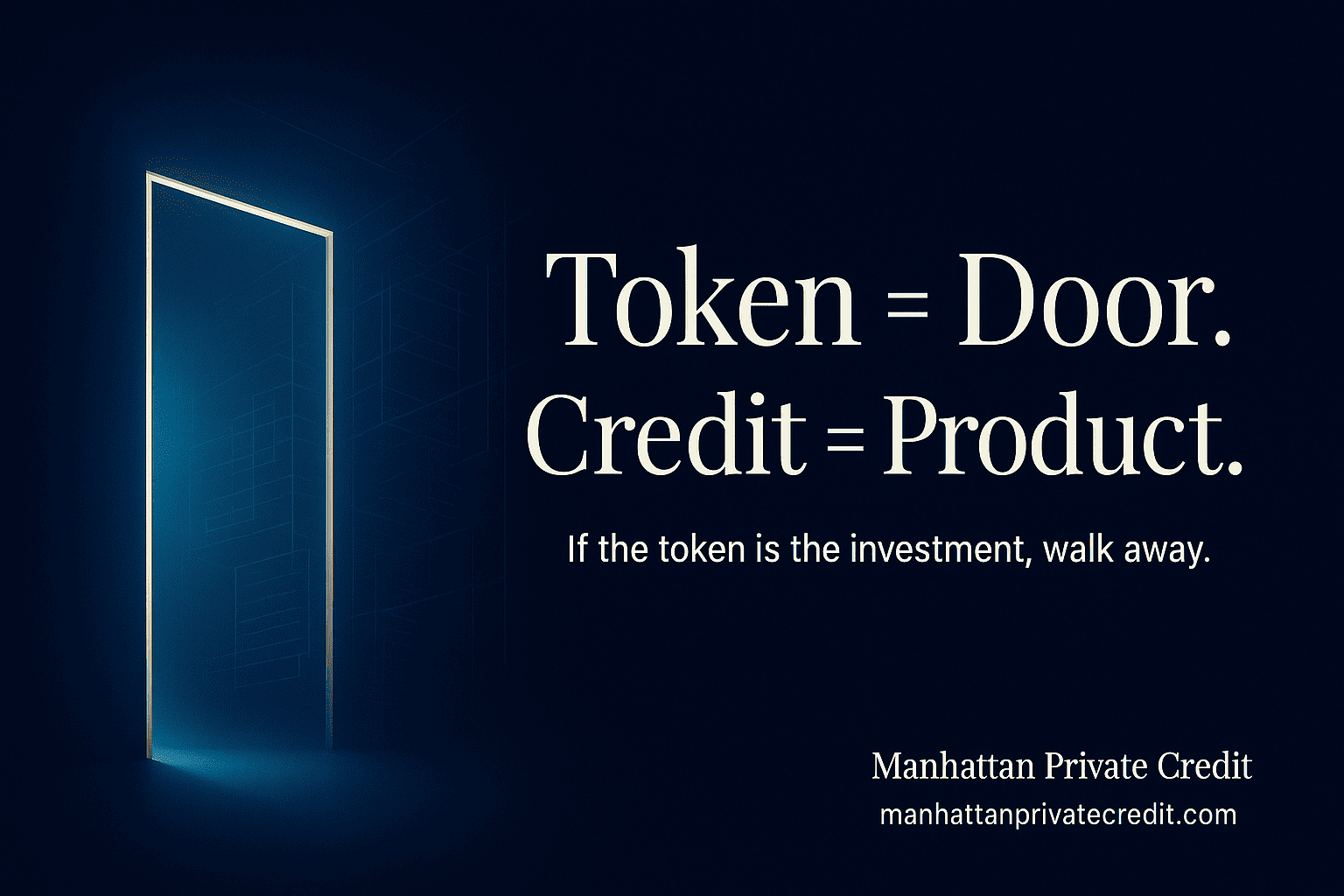
This piece lays out a simple mental model: the token is the door; the private credit is the product.
Why Tokenisation in the Private Capital Market Is Misunderstood
Most of the noise around tokenisation in private credit comes from the wrong side of the market.
How the crypto narrative blurred the signal
Crypto-first narratives did two things at once:
- Turned the instrument (the token) into the trade
- Pushed attention away from the underlying assets and into price screens
In that world, the question became: "What’s the token going to do?" rather than "What’s the asset actually worth, and who stands behind it?"
That framing might work for speculative flows. It does not work for institutional private credit.
When everything is described as a token, it becomes easy to:
- Confuse access mechanics with asset risk
- Mix real world assets and pure digital speculation in the same conversation
- Obscure the simple fact that loans still need to be underwritten, serviced, and repaid
What sophisticated investors actually care about: yield and control
Accredited investors, macro-aware operators, and institutional allocators don’t wake up asking for more tokens. They wake up asking:
- Where is the real yield?
- What is the downside?
- How clean is the structure and documentation?
- Who controls information, cash flows, and enforcement?
Tokenisation only matters to the extent it:
- Improves control over who can access which deals and on what terms
- Reduces friction in managing eligibility, ownership records, and transfers
- Tightens operational discipline around what is already a private, permissioned asset class
If the centerpiece of the pitch is the token, you’re probably looking at the wrong deal.
The Token Is the Credential. The Credit Is the Asset.
Think of tokenisation as a credentialing system, not as an investment thesis.
Token as membership: proving you belong in the room
In a networked private capital market environment, a token can function as your membership card.
It can prove, in a verifiable and programmable way, that you:
- Are who you say you are
- Meet certain criteria (e.g., accredited, qualified purchaser, institutional)
- Belong to a specific network or platform of investors
This is not about inflating the value of the card. It’s about tightening the rules of the room.
Token as qualification: proving you’re allowed to see the deal
Private credit is defined as much by who can see what as by the loans themselves.
Tokens can encode and enforce:
- Suitability and eligibility rules
- Jurisdictional constraints
- Investor type restrictions
In that sense, the token becomes a dynamic credential:
- It doesn’t tell you what to invest in
- It tells the system what you’re allowed to invest in
That’s a compliance and infrastructure story, not an upside story.
Token as access: controlling how you interact with private credit
Once you understand tokenisation as credentialing, the hierarchy is simple:
- The token is the door
- The private credit is the room
The token may:
- Allow you to view specific offerings
- Reflect your position or allocation
- Integrate with reporting, cap tables, or distribution flows
But the risk, return, and real decision-making still sit with the underlying:
- Borrowers
- Collateral
- Covenants
- Structures
The token is the interface. The credit is the exposure.
What Actually Drives Returns in a Tokenised Private Capital Market
For all the talk of "on-chain" and "tokenised real world assets", the engine hasn’t changed. Returns are still driven by credit work.
Real loans, real yield, real world counterparties
In a serious tokenised private credit structure, the underlying tends to look familiar:
- Corporate, sponsor-backed, or asset-based loans
- Event-driven or special-situation financings
- Structures with collateral, covenants, and negotiated protections
The yield comes from:
- Pricing of credit risk
- Structural protections
- Cash flows from real-world businesses or assets
None of that becomes more or less real because a token exists. The token can represent or record your interest. It does not generate the interest.
Underwriting still does the heavy lifting
Whether units are digitised or not, the hard work sits in:
- Sourcing the right situations
- Understanding capital structures and incentives
- Underwriting counterparties and downside scenarios
- Structuring terms that can survive volatility and stress
The question "Who underwrote this?" matters more than "What chain is this on?"
Where tokenisation changes operations, not economics
Where tokenisation can be useful is in the operational layer:
- Cleaner record-keeping of positions
- Automated enforcement of transfer and eligibility rules
- More efficient communication and reporting to a distributed investor base
Those are operational gains, not magic yield enhancers.
If the economics don’t make sense off-chain, they won’t make sense on-chain either.
How Investors Should Evaluate Tokenisation in the Private Capital Market
Approach tokenised private credit like you would any other private credit, with one adjustment: treat the token as infrastructure, and diligence it as such.
If the token is the pitch, ask where the loans are
A simple filter:
- If you’re being sold the token, ask: Where are the loans?
- If you’re being walked through the loans, the structure, and the manager, and the token shows up in the operations section, you’re closer to the right room.
The order of operations should be:
- Asset-level questions – borrower, purpose, collateral, structure
- Manager-level questions – track record, sourcing, workout discipline
- Structure-level questions – vehicle, rights, waterfalls, governance
- Technology-level questions – how tokenisation supports all of the above
Reverse that order, and you’re in marketing, not risk management.
Key questions to ask managers using tokenisation
When a manager mentions tokenisation, drill down into:
- Purpose: Why are you using tokenisation here? What specific problem does it solve?
- Scope: Is the token acting as a credential, a record of interest, or something else?
- Controls: How are eligibility, transfer restrictions, and compliance enforced?
- Alignment: Does tokenisation introduce any misalignment or additional counterparties between me and the cash flows?
- Resilience: What happens to my rights if the technology stack changes or fails?
You’re not trying to become a software auditor. You’re testing whether the token is:
- A necessary, disciplined piece of infrastructure, or
- A narrative layer masking a thin credit story
Red flags: when the access layer becomes the product
A few warning signs for accredited investors:
- The economics are explained in terms of token price appreciation, not loan performance
- The timeline focuses on liquidity events for the token, not the maturity and repayment profile of the credit
- Risk is described as volatility, not as probability and severity of loss
- The manager spends more time on protocol partnerships than on borrower-level detail
When the access layer becomes the pitch, the asset has usually gone missing.
The Strategic Role of Tokenisation in the Private Capital Market
When used correctly, tokenisation is simply infrastructure for a more connected private capital market ecosystem.
Smarter credentialing for a networked investor base
Private credit is increasingly:
- Global
- Networked
- Relationship-driven
At that scale, old tools for proving who is eligible for what start to break down.
Tokenisation can:
- Encode membership and eligibility once
- Reuse that credential across multiple strategies or vehicles
- Support a controlled, permissioned network of capital and opportunity
This is not about "democratising" anything. It’s about reducing friction inside the institutional universe.
Aligning compliance, eligibility, and access at scale
For allocators and managers, three constraints must always line up:
- Who can access the deal
- What they can see and hold
- Under which regulatory and structural rules
Tokenisation can tighten that alignment by:
- Automating eligibility checks before access is granted
- Preventing transfers to ineligible holders by design
- Making audit trails and reporting cleaner and more consistent
Again, this is credentialing. It lives in the legal, compliance, and operations stack—not in the investment committee memo.
What doesn’t change: discipline, documentation, downside focus
Even in a fully tokenised environment, the fundamentals of institutional private credit do not move:
- You still need tight documentation
- You still need downside protection
- You still need clear recourse and enforcement pathways
- You still need managers who have been through real cycles
Tokenisation can modernise the rails of the private capital market. It cannot replace judgment.
FAQ About Tokenisation and the Private Capital Market
Is tokenisation in private credit just another crypto trade?
No. In serious private credit structures, tokenisation is not the bet. It’s the plumbing. The token is a digital credential that proves who you are, what you qualify for, and what you can access. The actual risk and return profile comes from the underlying loans, not from token price action.
What does a token actually represent in a tokenised private credit deal?
Practically, the token represents membership, eligibility, and record-keeping. It can reflect your interest in a vehicle or pool, but its real function is as a controlled access key within a permissioned ecosystem. It is not, by itself, the source of yield. The credit underwriting and structure are.
How should accredited investors evaluate tokenised private credit opportunities?
Start by ignoring the technology pitch and asking traditional questions: Who is the borrower? What is the collateral? How is the deal structured? Who underwrites and services the loans? Then ask how tokenisation is used to manage eligibility, ownership, transfers, and reporting. If the story is mostly about the token, walk away.
Does tokenisation change the risk profile of private credit?
Tokenisation can change operational, legal, and transfer mechanics, but it does not magically change credit risk. The core risks remain: borrower performance, structure, covenants, recovery, servicing quality, and macro conditions. Tokens may introduce new layers of operational and regulatory risk that need to be understood and managed.
What is the main advantage of tokenisation in the private capital market?
The main advantage is cleaner, programmable credentialing: who can see what, who can hold what, and under which rules. It can make access, allocations, and reporting more efficient across a network of accredited and institutional investors. But the investment case still lives and dies with the loans and the manager.
Manhattan’s View: Connecting the Private Capital Market, Not Chasing Hype
At Manhattan Private Credit, we treat tokenisation the way institutional investors should: as infrastructure.
The focus is—and remains—on:
- Real private credit
- Real counterparties
- Real yield, grounded in underwriting and structure
Tokens may be the door. We care about the room: the quality of the loans, the discipline of the documents, and the clarity of investor rights.
If you’re looking for event-driven, alternative credit perspectives that separate signal from noise, learn more at manhattanprivatecredit.com.