
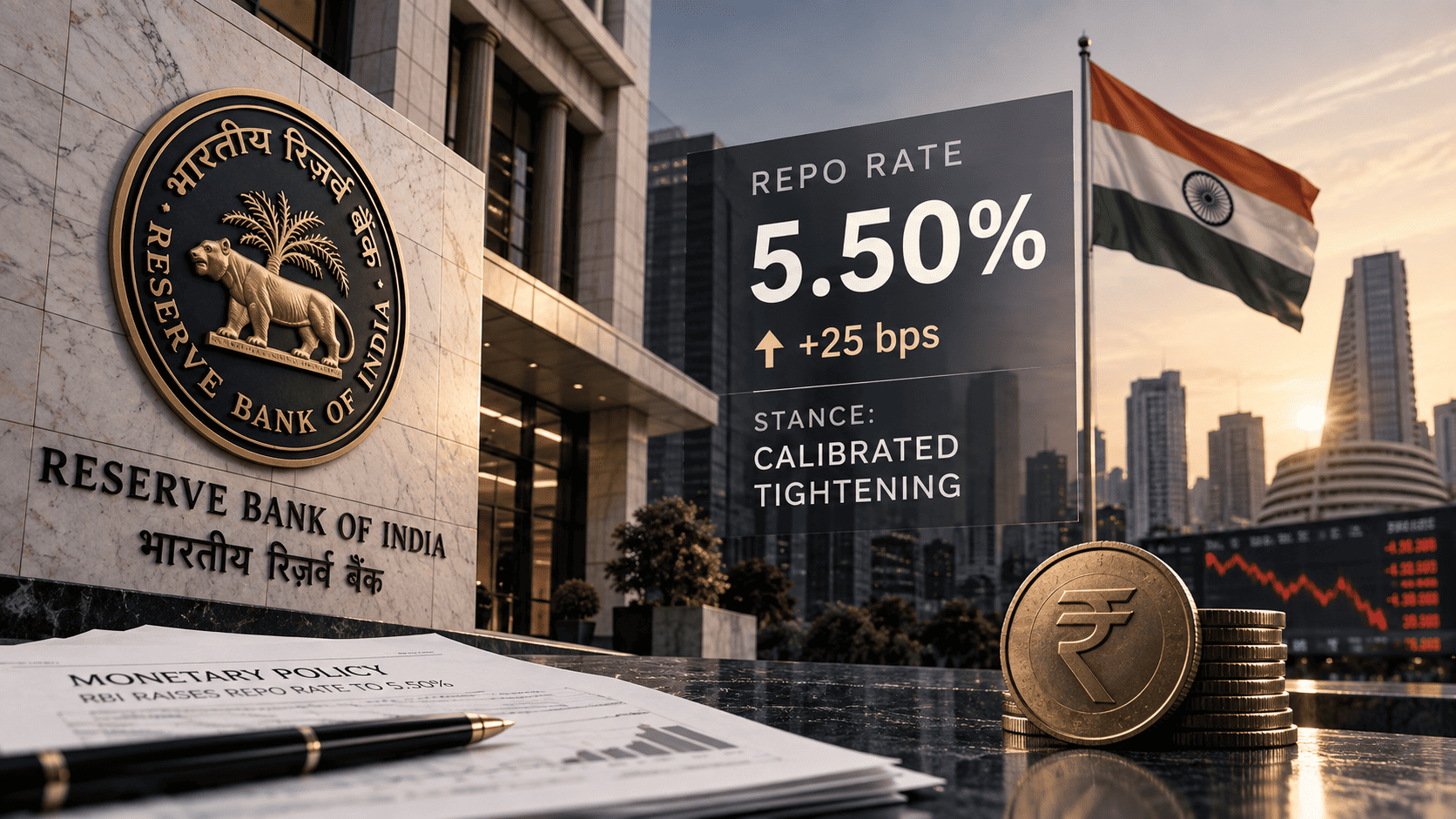
India’s first rate increase since February 2023 changes more than the policy rate. The RBI’s shift to calibrated tightening could reshape borrowing costs, private credit, NBFC funding and asset valuations.
The RBI repo rate hike marks a significant change in India’s cost-of-capital regime. The Reserve Bank of India raised the repo rate by 25 basis points to 5.50%, its first increase since February 2023, while changing its policy stance from neutral to calibrated tightening.
Governor Sanjay Malhotra made the new policy asymmetry clear: depending on economic conditions, the next move can be either another rate increase or a pause. The easing option has effectively been removed from the near-term policy framework.
That shift matters more than the size of the initial increase. It tells banks, non-bank lenders, borrowers and private-market investors that India’s discount rate has entered a tightening regime even as economic growth remains strong.
Public markets will absorb the change first. The more durable effects will move through bank lending, NBFC funding, refinancing schedules, infrastructure finance, private credit and private-market valuations.
What changed with the RBI repo rate hike
The Monetary Policy Committee increased the repo rate by 25 basis points to 5.50%, the first increase in more than three and a half years. At the same time, the RBI raised its FY2027 real GDP growth projection to 7.1% from 6.7% and increased its inflation forecast to 5.2% from 5.0%.
August consumer-price inflation stood at 4.82%, marking the third consecutive month above the RBI’s 4% medium-term target, although inflation remained within the 2–6% tolerance band.
This is not a conventional tightening cycle driven by collapsing growth expectations. The RBI has room to tighten partly because economic activity remains resilient, while imported inflation—particularly from energy—poses a growing risk.
Brent crude was trading at approximately US$101.50 per barrel during the Indian session. India’s dependence on imported energy makes the transmission particularly important. Higher oil prices increase the import bill, place pressure on the rupee, raise transport and production costs and can eventually feed into wages and services.
The RBI’s stronger growth forecast should therefore not automatically be interpreted as positive for long-duration assets. Strong growth is part of what gives the central bank room to maintain tighter monetary conditions.
How higher RBI rates reach private balance sheets
The most important question for investors is how a higher repo rate moves from monetary policy into corporate and household balance sheets.
The first transmission channel is floating-rate bank credit. Repo-linked retail and corporate loans can reprice mechanically, while banks may also adjust marginal-cost lending rates as deposit and wholesale funding costs increase. Borrowers with home loans, vehicle financing and working-capital facilities can therefore face either higher interest expense or longer repayment periods.
The second channel is non-bank finance. Indian non-bank financial companies, or NBFCs, commonly fund themselves through combinations of bank borrowing, bonds and securitisation. A higher risk-free rate and more expensive bank funding can compress net interest margins unless lenders successfully pass those costs to borrowers.
The underlying credit risk may therefore emerge downstream. The vulnerable point is not necessarily the lender that increases its rate, but the borrower whose cash flow cannot absorb the higher financing cost.
The third channel is asset valuation. Infrastructure, real estate, digital platforms and growth equity are long-duration assets. A higher discount rate reduces the present value of distant cash flows while increasing the hurdle rate required for new investment.
Transactions that appeared financeable under the previous rate environment may consequently require more equity, lower entry valuations or stronger creditor protections.
Private-credit spreads do not necessarily have to widen immediately if system liquidity remains ample and competition between lenders remains strong. But total borrower coupons can still increase when the underlying base rate rises.
That distinction matters: a stable credit spread over a higher base rate still represents tighter financing conditions.
India’s market reaction signals repricing, not stress
Indian equities declined broadly following the RBI decision. At 10:09 a.m. IST, the Nifty 50 was down 0.77% at 22,599.1, while the Sensex had fallen 0.65% to 72,594.57.
All 16 major sectors were lower. Autos declined 1.1%, consumer staples fell 0.7%, and financials, banks and real estate lost approximately 0.4–0.5%.
The moves were orderly and should be interpreted as repricing rather than market dislocation. The sector pattern is nevertheless informative. Rate-sensitive consumption, property and financial companies were immediately marked down because investors understand how higher rates transmit through those business models.
The more consequential risk is the interaction between oil prices, the rupee and global bond yields.
If energy prices remain above US$100 per barrel while major global central banks maintain restrictive monetary policy, the RBI could face pressure to defend domestic price stability and currency credibility at the same time.
Under that scenario, calibrated tightening could evolve from a single adjustment into a broader rate cycle.
Why the RBI rate hike matters for private credit
For private-credit investors, the key issue is not simply whether yields rise. It is whether borrower cash flows can absorb the increase.
A higher base rate can improve headline coupons on floating-rate loans, creating an apparent benefit for lenders. But that benefit weakens if interest coverage deteriorates, refinancing becomes more difficult or default probability rises.
This makes capital structure increasingly important.
Senior loans with strong collateral, maintenance covenants, cash sweeps and meaningful equity cushions should be better positioned than unsecured or highly leveraged exposures. Investors also need to stress-test interest coverage at higher rates rather than relying on the borrower’s existing financing cost.
India’s private-credit market could still benefit from tighter monetary conditions. As conventional financing becomes more selective, private lenders may gain negotiating power and access to borrowers willing to pay for certainty of execution.
But higher yield should not be confused with better credit.
The opportunity improves only when pricing rises faster than underlying risk.
NBFC funding could become an important pressure point
India’s NBFC sector deserves particular attention because the monetary-policy transmission can operate through both sides of the balance sheet.
Funding costs can increase as bank borrowing and bond-market financing become more expensive. At the same time, NBFCs need to decide how much of that increase can be passed through to their own borrowers without damaging credit performance.
Well-capitalised lenders with diversified funding and strong access to deposits or capital markets should have more flexibility. Institutions dependent on wholesale funding may face greater pressure.
This creates a second-order credit question: even when the original lender remains financially sound, tighter funding conditions can migrate through the system toward smaller companies, property developers and consumers with less ability to absorb higher borrowing costs.
Deposit competition and NBFC funding spreads will therefore provide important evidence about whether the RBI tightening cycle is transmitting smoothly or creating isolated pockets of liquidity stress.
Higher rates could reset Indian private-market valuations
The impact of the RBI repo rate hike extends beyond credit markets.
Higher discount rates directly affect the valuation of long-duration assets, including infrastructure, real estate, technology platforms and growth equity. The effect can become particularly important when higher domestic rates coincide with elevated energy costs and restrictive global financial conditions.
Private-market valuations typically adjust more slowly than public prices. That creates the possibility of a temporary gap between reported asset values and the financing conditions available for new transactions.
Private-equity sponsors may encounter a wider difference between seller expectations and debt-supported purchase prices. Refinancing timelines may extend, additional equity may be required, and exits can be delayed while buyers and sellers adjust to the new cost of capital.
For private-credit investors, that adjustment can create opportunities, particularly where fundamentally sound assets require refinancing but traditional lenders become more conservative.
It can also expose weak underwriting from the previous rate environment.
Where capital may move as India tightens
A higher-rate environment should initially favour cash, short-duration assets and high-quality floating-rate credit, where coupons can reset faster than borrower credit quality deteriorates.
Well-capitalised banks with strong funding franchises should be better positioned than lenders heavily dependent on wholesale markets. Private lenders with genuine seniority, hard collateral, maintenance covenants and cash-sweep protections may also gain leverage as marginal financing becomes scarcer.
The opportunities will not be distributed evenly across the economy.
Infrastructure assets with contracted or inflation-linked revenues may remain attractive because their cash flows can provide some protection against higher financing costs. Exporters earning revenue in US dollars could prove more resilient than domestically financed companies exposed simultaneously to energy inflation and discretionary consumer demand.
Special-situations investors may also find more attractive entry points as refinancing deadlines approach.
The more vulnerable areas include highly leveraged real estate, unsecured consumer lending, weak NBFC funding chains and projects whose economics depend on cheap refinancing.
The distinction between these groups should become increasingly important if the RBI remains in a tightening regime.
The oil and rupee connection matters
India’s monetary-policy outlook cannot be separated from energy markets.
As a major energy importer, India is particularly exposed when crude prices rise. Higher oil prices can widen the import bill, weaken the currency and transmit additional inflation through transport, manufacturing and consumer prices.
A weaker rupee can then amplify imported inflation, potentially forcing the RBI to maintain tighter policy even if parts of the domestic economy begin to slow.
This creates an important feedback loop for credit investors:
higher oil prices → greater inflation pressure → tighter monetary policy → higher financing costs → weaker borrower coverage.
The severity of that chain will depend on energy prices, currency stability and how effectively businesses can pass higher costs to customers.
Key risks for investors and lenders
The first risk is duration. Long-dated assets become more sensitive to discount-rate changes when the expected easing cycle disappears.
The second is refinancing risk. Borrowers that assumed cheaper future debt may discover that maturity extensions require higher coupons, additional collateral or more sponsor equity.
The third is funding concentration. NBFCs and other lenders dependent on wholesale financing can face pressure faster than institutions with diversified funding bases.
The fourth is energy inflation. Persistent oil prices above US$100 could increase both inflation and currency pressure, making it harder for the RBI to return to an easing stance.
Finally, there is valuation lag. Private assets do not reprice continuously, which means reported valuations can remain stable even after the economic cost of financing has materially changed.
For lenders, that makes current cash flow and downside protection more important than historical marks.
What Manhattan is watching
The first signals are the rupee and India’s sovereign yield curve. A weaker currency or another increase in long-term yields would indicate that one rate increase has not fully restored confidence in the inflation outlook.
The second is deposit competition and NBFC funding spreads. These will show whether tighter monetary policy is transmitting smoothly through the financial system or creating liquidity pressure in particular segments.
The next two inflation readings will also be important, particularly the components related to food, fuel and services. Headline inflation can reverse relatively quickly; second-round inflation embedded in wages and services is harder to remove.
Manhattan is also watching refinancing activity across commercial property, infrastructure and sponsor-backed companies. More amend-and-extend transactions, higher equity contributions or tighter covenant packages would provide direct evidence that monetary tightening is reaching private balance sheets.
Finally, RBI liquidity operations will determine how powerful the policy-rate increase becomes. A restrictive stance combined with abundant system liquidity can soften transmission. Sustained liquidity withdrawal would make the tightening cycle materially stronger.
Manhattan View: India has entered a new cost-of-capital regime
The 25-basis-point RBI repo rate hike is the headline. The regime change is the more important story.
India continues to offer one of the strongest growth profiles among major economies, but that growth no longer comes with an easing bias. Investors should therefore resist interpreting higher coupons as automatically representing better value.
When the base rate, energy bill and refinancing hurdle rise together, structure becomes more important than yield.
For private-market investors, the response should be disciplined: favour shorter duration, real cash flow, genuine seniority and explicit downside protection. Require more equity beneath the debt, test interest coverage at higher rates and treat optimistic refinancing assumptions as a risk rather than a solution.
India has not entered a credit crisis. It has entered a more disciplined price-of-capital regime.
That distinction could create opportunities for lenders willing to price risk correctly before private-market valuations fully adjust.
Structure first. Yield second. Access only matters when the structure is worth accessing.
Sources
- Reserve Bank of India — Monetary Policy Statement and Resolution, 7 October 2026
- Reserve Bank of India — Governor’s Statement, 7 October 2026
- Reuters — Indian shares after the RBI rate decision, 7 October 2026
- The Indian Express — RBI raises repo rate to 5.50%
This material is general financial information only and does not constitute investment, legal, tax or credit advice. Investors should assess suitability, liquidity and risk independently before acting.