
AI credit risk is becoming a more visible influence on infrastructure financing. Investors are increasingly using credit default swaps, or CDS, to manage exposure to the companies funding the AI build-out. That gives lenders and portfolio managers another market signal to assess alongside share prices, bond yields and private valuations.
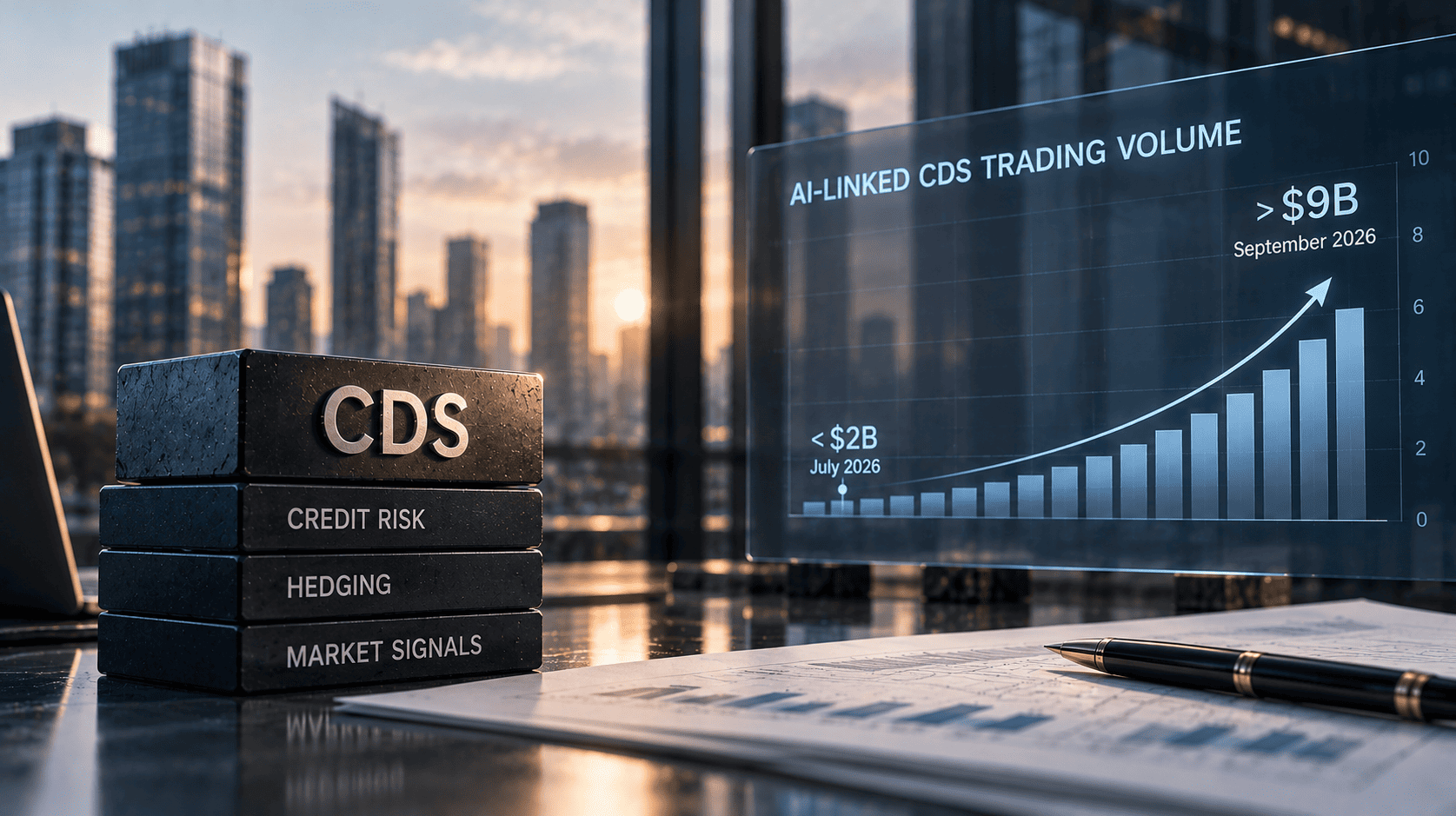
The Financial Times reported that average weekly CDS trading linked to a group of AI-exposed companies exceeded US$9 billion in September, compared with less than US$2 billion in July, citing Morgan Stanley Research. The increase shows a sharp expansion in trading activity, although turnover alone does not reveal investors’ net positions or prove that the market could absorb large trades during stress. ft.com
For private capital, the implication is significant. Public credit markets are providing faster feedback on the cost and risk of financing AI infrastructure. The challenge is interpreting that feedback without treating corporate default protection as a perfect measure of every project or private loan.
Why AI credit risk is attracting more hedging
The AI investment cycle increasingly depends on financing structures that create fixed payment obligations. Bonds, equipment loans, private-credit facilities, leases and project vehicles allow companies to expand capacity before the resulting revenue arrives. They also expose borrowers to interest costs, construction delays, refinancing requirements and changes in hardware value.
Credit default swaps provide one way to manage the resulting exposure. The protection buyer pays a premium, while the seller agrees to compensate it following a contractually defined credit event, subject to the agreement’s terms. A wider CDS spread generally means protection has become more expensive.
Demand for protection can reflect several motives. Bondholders may hedge existing investments, lenders may manage concentration limits, and other investors may express a negative credit view. Consequently, increased trading should be read alongside spreads, outstanding exposure and market conditions. It is a signal of greater activity around risk, rather than a direct forecast of losses.
CoreWeave shows how quickly credit conditions can change
CoreWeave illustrates the sensitivity of AI financing to credit-market repricing. Reuters reported on 15 October that its five-year CDS spread moved above 1,100 basis points. The yield on its 2031 bond reached as much as 16% before retreating towards 14%, showing how volatile financing signals had become. reuters.com
These measures describe different things. A bond yield reflects its market price and promised cash flows, while a CDS spread prices contractual credit protection. Neither establishes that default is imminent. Both can nevertheless indicate that investors require greater compensation for holding or underwriting exposure.
CoreWeave’s June-quarter filing, cited in the original analysis, reported US$103.7 billion of remaining performance obligations, with 41% expected to be recognised over the following 24 months. That provides visibility into contracted business, but it does not represent cash already collected. Revenue recognition, customer payments and available liquidity follow different schedules.
The same filing described substantial equipment financing and additional funding commitments. Those obligations should be assessed individually, accounting for their timing, conditions and potential overlap. The central underwriting question is whether operating cash arrives quickly enough to meet financing and deployment costs.
How CDS spreads can affect AI debt financing
CDS spreads do not mechanically determine a company’s borrowing rate. However, they can influence how lenders assess credit quality, compare opportunities and price new transactions. Persistent widening may contribute to demands for higher spreads, more collateral, stronger covenants or additional sponsor equity.
The effect depends on the borrower and the financing structure. An operating facility with contracted revenue and limited remaining capital expenditure may withstand market volatility differently from a development platform that needs repeated funding rounds.
A potential feedback loop follows. Higher financing costs can reduce project returns, which may weaken equity valuations and make fresh capital harder to obtain. Reduced financial flexibility can then increase concern about refinancing. This is a possible transmission mechanism, rather than evidence that every AI borrower is already experiencing it.
Hedging can also support continued lending. A lender able to reduce selected exposures may retain more capacity to finance new projects. The availability of protection can therefore improve risk management, even when rising protection costs signal greater caution.
What AI credit risk means for private lenders
For private-credit managers, public CDS prices offer an external reference point. They can prompt a review of assumptions about borrower leverage, customer concentration, refinancing costs and recovery values. They can also help identify where private valuations have yet to reflect changing market conditions.
However, a corporate CDS contract may be an imperfect hedge for a private loan. The loan could be secured by particular equipment, customer contracts or project assets, while the CDS references a different entity or obligation. Differences in seniority, maturity and restructuring provisions can further weaken the relationship.
This mismatch is known as basis risk. Protection may become more valuable without fully offsetting losses on the private exposure, or the loan may remain well protected while the corporate CDS spread widens sharply. Effective underwriting therefore requires analysis of the actual obligor, collateral and payment structure.
A market quote can challenge an investment thesis. It cannot replace the underlying credit work.
Which AI infrastructure structures may attract capital?
Manhattan’s analysis is that financing will become more selective as lenders distinguish operating assets from development promises. Projects with reliable power, enforceable customer commitments and credible completion plans may be better positioned to obtain funding on workable terms.
The alignment of cash flows and debt repayments is especially important. Scheduled amortisation can reduce refinancing dependence when it is supported by realistic customer payments. By contrast, a structure relying heavily on a large final repayment may remain exposed to future market access and uncertain equipment values.
Staged drawdowns can also improve discipline by linking funding to verified progress. Meaningful sponsor equity and clear remedies for delays may strengthen lender protection. Senior secured status can help, but its value still depends on enforceability, collateral quality and recoverable cash flows.
These distinctions matter more than a broad “AI-backed” label. Two loans financing similar technology can produce very different outcomes because their contracts allocate risk differently.
The limits of CDS as a warning signal
CDS pricing requires careful interpretation. Implied default probabilities depend on modelling assumptions, including recovery rates, and incorporate risk premiums and market conditions. They should not be presented as objective predictions of how often a borrower will default.
Trading volume has limits as well. High turnover can include repeated transactions and the adjustment of existing positions. It does not, by itself, establish the depth of liquidity available during a market shock.
Correlation presents another challenge. AI borrowers can share customers, suppliers, power dependencies and financing providers. A problem affecting one participant may change assumptions across several exposures, even where the legal borrowers differ.
Private valuations may respond more slowly because reporting cycles and valuation methods differ from those in public markets. That lag warrants investigation; apparent stability alone does not establish that a private asset carries less risk.
What Manhattan is watching
The next test is whether increased CDS activity persists and translates into different financing terms. Manhattan Private Network is monitoring protection costs alongside new loan spreads, advance rates, covenant packages and sponsor-equity requirements.
Operating performance will be equally important. Customer cash collections, deployment milestones, power availability and remaining capital expenditure will show whether contracted demand is becoming usable capacity and cash flow. Those measures provide essential context for interpreting market volatility.
For private lenders using hedges, the focus should include reference-entity alignment, collateral obligations and termination provisions. A hedge needs to remain useful when the underlying exposure is difficult to sell.
Manhattan view: follow the signal, test the structure
Rising CDS activity gives investors another way to assess AI credit risk. It can improve discipline by making financing concerns visible sooner and encouraging lenders to revisit optimistic assumptions.
The signal still needs context. Contracted demand does not guarantee timely cash collection, and corporate protection does not automatically hedge a bespoke private asset. The strongest analysis connects market pricing to the borrower’s actual obligations and the lender’s enforceable rights.
Structure first. Yield second. When the hedge becomes the signal, the financing must be able to withstand the risks that signal reveals.
Sources
- Financial Times: AI debt worries spark surge in default insurance trading, 20 October 2026.
- Reuters: AI credit worries send default insurance to record high, 15 October 2026.
- Reuters: CoreWeave’s AI contracts and the lenders financing its build-out, 15 October 2026.
- CoreWeave Form 10-Q for the quarter ended 30 June 2026.
This material is for general financial information and education only. It does not constitute investment, legal, tax or financial advice, or an offer or recommendation.