
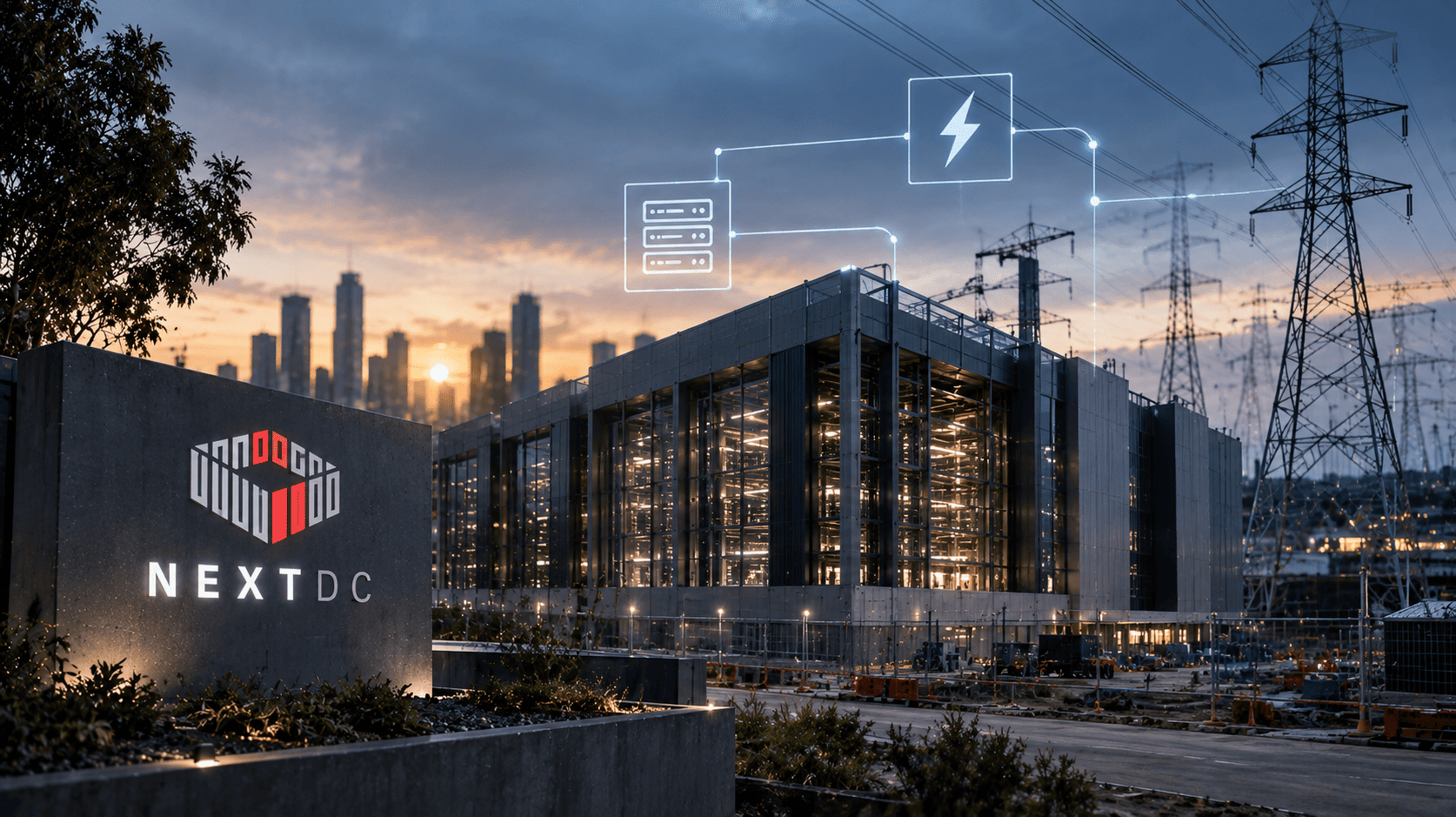
NEXTDC power delays have exposed a critical vulnerability in AI infrastructure financing: customer commitments cannot generate the expected cash flow until reliable electricity is available. The Australian data centre operator sharply reduced its FY2027 earnings outlook after electricity-network works serving its M3 Melbourne campus were delayed. Its shares fell as much as 44% following the announcement. tradingview.com
The setback highlights the gap between signing customers and delivering operational capacity. For investors and private lenders, that gap affects revenue timing, financing requirements and the value of infrastructure already built. Strong demand can support a project’s commercial case while power constraints prevent it from meeting its financial targets.
How NEXTDC power delays changed FY2027 guidance
NEXTDC reduced FY2027 net-revenue guidance to A$475 million–A$500 million from A$615 million–A$640 million. Underlying EBITDA guidance fell to A$245 million–A$265 million from A$385 million–A$410 million. At the respective midpoints, the reductions are approximately 22% for net revenue and 36% for underlying EBITDA.
The company attributed the revision to delays affecting power supply at M3. Jemena Electricity Networks suspended parts of the required network upgrade following community and stakeholder opposition. The next increase in grid supply is now expected in FY2028, while a planning decision concerning M3 Stages 6 and 7 is expected after Victoria’s 28 November 2026 election.
Approximately A$140 million of net revenue and a similar amount of underlying EBITDA associated with affected customer contracts were excluded from FY2027 guidance. The exclusion includes capacity already billing because available electricity cannot reliably support the full contracted power ramp in completed data halls. NEXTDC is working with the affected customer on a revised schedule.
These are changes to expected earnings, rather than evidence that all affected customer demand has disappeared. However, a delay in revenue can still materially weaken project returns when construction and financing costs have already been incurred.
Why contracted demand is different from operating cash flow
Data centre development requires several dependencies to come together. A signed customer contract must be supported by planning approval, construction, electricity supply, equipment installation and customer acceptance. Billing and cash collection depend on the relevant contractual conditions being met.
The M3 delay demonstrates why power delivery belongs at the centre of financial underwriting. Completed buildings and customer commitments have limited near-term earning capacity when the electricity needed for the customer’s planned usage is unavailable.
Investors therefore need to distinguish operating capacity from development-stage commitments. Powered facilities already billing customers have a different risk profile from completed facilities awaiting electricity, projects under construction and prospective demand without binding contracts. Valuation and lending assumptions should reflect those differences.
The wider lesson is that announced capacity is only one part of the investment case. The timetable and enforceability of the path to operation determine when that capacity can begin supporting debt service.
NEXTDC reduces spending and reviews development assets
NEXTDC lowered FY2027 capital-expenditure guidance to A$4.5 billion–A$5.0 billion from A$5.25 billion–A$5.75 billion. It also deferred uncontracted expansions, suspended new development projects and land acquisitions for the foreseeable future, and said it would consider capital recycling, including possible sales of selected development sites.
Those measures redirect resources towards existing commitments and projects with a clearer route to revenue. Development land can provide valuable future options, but it also creates holding costs when approvals and electricity delivery remain uncertain.
Capital recycling may preserve financial flexibility. Its effectiveness will depend on buyer demand, sale terms and the value attributed to each site’s planning and power position. A development asset may attract a different valuation once its expected operating date moves further into the future.
This response also illustrates how power constraints can affect investment decisions before a borrower defaults. Delays can change which projects receive funding, how much equity is required and whether expansion remains economically attractive.
Liquidity provides time, but does not guarantee returns
NEXTDC reported A$8.675 billion of liquidity at 30 September, compliance with financial covenants and no scheduled debt maturity before December 2029. Convertible-note holders have a potential put option in September 2029, which is also relevant when assessing future funding requirements.
Reported liquidity should be examined by component, including cash and available facilities, together with any conditions governing access. It should not automatically be interpreted as unrestricted cash available for every purpose.
Financial flexibility can give management time to revise construction schedules and negotiate with customers. Nevertheless, a funded project can still suffer lower returns if revenue is delayed, completion costs rise or asset values decline. NEXTDC warned that timing and completion costs could affect the fair value of investment properties.
For creditors and shareholders, liquidity and profitability therefore require separate assessment. Available funding helps a business manage disruption; it does not restore the original project economics by itself.
What NEXTDC power delays mean for private credit
For private lenders, the immediate implication is stronger scrutiny of energisation risk. Underwriting should establish who is responsible for network delivery, which milestones are enforceable and what remedies exist if electricity arrives late.
Delayed-draw facilities can link funding to verified progress, reducing the amount advanced before a project is ready to use it. Depending on the transaction, lenders may also seek larger equity contributions, interest reserves and limits on speculative development.
Customer contracts require equally careful review. Minimum payments, ramp schedules, acceptance conditions, termination rights and potential service credits determine how much protection remains during a delay. A large contracted-revenue figure cannot answer those questions on its own.
Collateral analysis also becomes more specific to the site. Recovery value depends on the facility’s alternative uses, the availability of power and whether relevant rights can be transferred. A specialised building without a dependable connection may take longer to sell or repurpose than a valuation model assumes.
Where infrastructure capital could move
Manhattan’s analysis is that investors may place greater value on operating facilities and sites with demonstrable electricity availability. Existing connections, completed upgrades and credible delivery milestones can reduce uncertainty around the start of billing.
Investment opportunities may also emerge in the infrastructure enabling compute capacity, including substations, transmission, storage and dedicated generation. Each carries its own planning, construction and operating risks, so exposure to a bottleneck does not automatically produce an attractive return.
Alternative power can improve a project’s timetable, but it changes the cost structure. Additional generation may introduce fuel exposure, emissions requirements, permitting needs and ongoing maintenance obligations. Those costs must be compared with the economics of waiting for a grid connection.
The likely result is greater differentiation between projects. Sites with reliable delivery paths may retain access to capital, while uncertain developments face revised valuations or more demanding financing terms.
What Manhattan is watching
The next important disclosures are the revised M3 customer ramp schedule, progress on network works and the planning decision for the remaining development stages. Together, they will clarify how much delay remains and whether the revised earnings assumptions are achievable.
Manhattan Private Network is also monitoring potential customer credits, completion-cost changes, investment-property valuations and the terms of any asset sales. Covenant headroom and conditions attached to available facilities will help establish how much financial flexibility the company retains.
Across the sector, changes in lending terms will indicate whether the episode is influencing underwriting more broadly. Lower advance rates for unpowered capacity or tighter funding milestones would show that electricity-delivery risk is being reflected more explicitly in financing.
Manhattan view: power delivery determines revenue timing
The NEXTDC setback shows how infrastructure constraints can interrupt the conversion of customer demand into cash flow. Power, approvals, construction and customer obligations must work together before a development pipeline can support its expected financial returns.
For investors, the useful distinction is between capacity that has been contracted and capacity that can be delivered on a credible timetable. Both have value, but they carry different execution and financing risks.
Structure first. Yield second. Access only matters when the infrastructure can deliver the cash flow supporting the investment.
Sources
- NEXTDC market announcement, 21 October 2026.
- Reuters: Australian AI data centre operator NEXTDC shares shed 44% on revenue delay, 21 October 2026.
- NEXTDC 1H26 results presentation.
This material is general financial information and editorial analysis for Manhattan Private Network. It is not personal financial advice, investment research or a recommendation to buy, sell or hold any security or financial product.